

Hey there! As a front grille mould supplier, I often get asked about how to measure the performance of these moulds. It's a crucial topic because a high - performing front grille mould can make a huge difference in the quality of the final product and the efficiency of the production process. In this blog, I'll share some key aspects and methods to measure the performance of a front grille mould.
1. Dimensional Accuracy
One of the most fundamental aspects of a front grille mould's performance is its dimensional accuracy. The front grille needs to fit precisely into the vehicle's design, and any deviation can lead to assembly issues. To measure dimensional accuracy, we usually use precision measuring tools like coordinate measuring machines (CMMs). These machines can accurately measure the length, width, height, and other critical dimensions of the moulded grille.
We compare the measured dimensions with the design specifications. For example, if the design calls for a grille to have a width of 1200mm with a tolerance of ±0.5mm, the CMM will tell us if the actual width of the moulded grille falls within this range. A high - performing mould should consistently produce grilles that meet these tight dimensional tolerances.
2. Surface Finish
The surface finish of the front grille is also very important. A smooth and defect - free surface not only looks good but also affects the aerodynamics and durability of the grille. To measure the surface finish, we can use surface roughness testers. These devices measure the height variations on the surface of the grille.
A good front grille mould should produce grilles with a surface roughness that meets the automotive industry standards. For instance, a typical requirement might be a surface roughness of Ra ≤ 0.8μm. If the surface finish is too rough, it can cause problems such as increased wind noise or premature wear of the grille.
3. Production Efficiency
Production efficiency is another key factor in measuring the performance of a front grille mould. We can measure this in terms of cycle time and production yield.
The cycle time is the time it takes to complete one full production cycle, from the moment the mould is closed, the plastic is injected, cooled, and the grille is ejected. A high - performing mould should have a relatively short cycle time. For example, if a competitor's mould has a cycle time of 60 seconds, and our mould can achieve a cycle time of 45 seconds, it means our mould is more efficient.
Production yield refers to the percentage of good - quality grilles produced in a batch. A high - performing mould should have a high production yield, ideally close to 100%. If there are a lot of defective grilles due to issues like flash, short shots, or warping, it indicates that the mould's performance needs improvement.
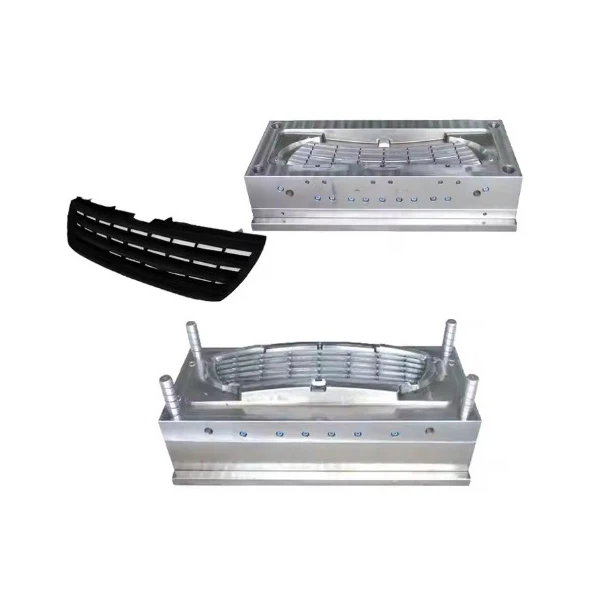

4. Durability
The durability of a front grille mould is crucial, especially for high - volume production. We can measure durability by looking at the number of production cycles the mould can withstand before it starts to show signs of wear and tear.
A well - designed and manufactured mould should be able to produce thousands or even tens of thousands of grilles without significant degradation in performance. For example, a high - quality mould might be able to produce 50,000 grilles before it needs major maintenance or replacement. We can monitor the mould's condition regularly through visual inspections and non - destructive testing methods like ultrasonic testing to detect any internal cracks or defects.
5. Ejection Performance
Proper ejection of the moulded grille is essential for a smooth production process. If the grille gets stuck in the mould during ejection, it can cause damage to the grille and the mould itself. To measure the ejection performance, we can observe the ease with which the grille is ejected and check for any signs of deformation or damage on the grille during ejection.
A good front grille mould should have a reliable ejection system that can quickly and smoothly eject the grille without leaving any marks or causing any warping. We can also measure the ejection force required to remove the grille from the mould. If the ejection force is too high, it might indicate problems with the mould design or the surface finish inside the mould.
6. Compatibility with Materials
The front grille mould needs to be compatible with the plastic materials used for production. Different plastics have different melting points, shrinkage rates, and flow properties. A high - performing mould should be able to work well with a variety of materials.
We can measure the compatibility by observing the quality of the moulded grilles when using different materials. For example, if we switch from one type of polypropylene to another, the mould should still be able to produce grilles with consistent dimensional accuracy and surface finish. We can also analyze the flow patterns of the plastic inside the mould using simulation software to ensure that the mould is optimized for different materials.
7. Cost - effectiveness
Finally, cost - effectiveness is an important aspect of measuring the performance of a front grille mould. This includes not only the initial cost of the mould but also the cost of operation and maintenance over its lifespan.
A high - performing mould might have a higher initial cost but can save money in the long run due to its high production efficiency, low defect rate, and long durability. We can calculate the total cost of ownership (TCO) of the mould, which includes the purchase price, cost of energy, labor, maintenance, and replacement parts. A mould with a lower TCO is considered more cost - effective.
If you're in the market for high - quality front grille moulds, I'd like to draw your attention to some of our great products. Check out our Automotive Radiator Grille Tooling Mold, Radiator Grille Mould, and Automotive Grille Injection Mould. These moulds are designed and manufactured to meet the highest standards of performance.
If you're interested in learning more about our front grille moulds or want to discuss a potential purchase, don't hesitate to reach out. We're always happy to have a chat and see how we can meet your specific needs.
References
- "Automotive Mould Design and Manufacturing Handbook"
- "Plastic Injection Moulding Technology"
- Industry standards and guidelines from automotive associations