

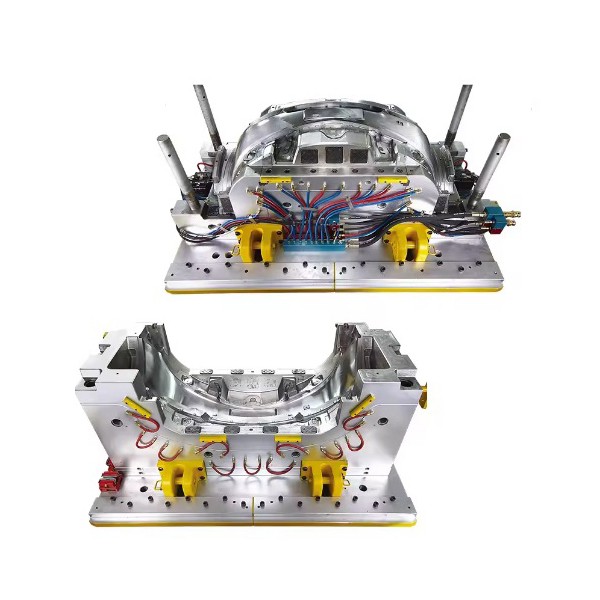
Bumper Mould
Bumpers are typically made from plastic or rubber, and the mould is used to give the bumper its desired shape and features. Bumper moulds are usually made from metal steel or other durable materials (p20, 1.2738), as they need to be able to withstand the high pressures and temperatures involved in the moulding process.
Advantages of Bumper Mould
Precision
Bumper moulds allow for precise control over the shape and features of the bumper, ensuring that it meets the desired specifications.
Efficiency
Bumper moulds can be used to manufacture large numbers of bumpers quickly and efficiently, making them a cost-effective choice for mass production.
Customization
Bumper moulds can be customized to meet the specific needs of the customer, allowing for the creation of unique and customized bumpers.
Durability
Bumper moulds are typically made from durable materials that are able to withstand the high pressures and temperatures of the moulding process, ensuring a long service life.
-
![Car Front Bumper Mold]() Car Front Bumper MoldThe production process of the front bumper mold of the car mainly includes the following steps:read more
Car Front Bumper MoldThe production process of the front bumper mold of the car mainly includes the following steps:read more -
![Rear Bumper Mould]() Rear Bumper MouldThe production process of the rear bumper mold mainly includes the following steps:read more
Rear Bumper MouldThe production process of the rear bumper mold mainly includes the following steps:read more -
![Front Bumper Mould]()
-
![Compression Molds For Automotive]() Compression Molds For AutomotiveThe displayed pictures is only for your reference. We can make differernt kinds of SMC, BMC, GMT compression mold according to customers' requirements.read more
Compression Molds For AutomotiveThe displayed pictures is only for your reference. We can make differernt kinds of SMC, BMC, GMT compression mold according to customers' requirements.read more -
![Car Lamp Injection Mold]() Car Lamp Injection MoldAutomobile headlight molds are tools used to manufacture and produce automobile front and rear headlights. They are usually processed from metal materials (such as aluminum alloy) and have shapes...read more
Car Lamp Injection MoldAutomobile headlight molds are tools used to manufacture and produce automobile front and rear headlights. They are usually processed from metal materials (such as aluminum alloy) and have shapes...read more -
![Bumper Injection Mould]() Bumper Injection MouldThe Advantages Of Bumper Injection Molds Mainly Include The Following Aspects:read more
Bumper Injection MouldThe Advantages Of Bumper Injection Molds Mainly Include The Following Aspects:read more


Why Choose Us
Quality assurance
Our plastic moulds company with high quality standards, detailed mould specifications and special requirements, enabling us to offer our customers a comprehensive solution to their injection molding needs.
Comprehensive solution
We have mastered product development, mold design, raw material selection, process optimization, production management, quality control, customer service, international freight forwarding, etc.Can offer our customers a comprehensive solution to their injection molding needs.
Professional team
Through years of experience in the manufacture of injection molding, we have cultivated an excellent team and established a comprehensive system to meet different needs of customers.
Competitive price
We seek to reduce costs for our customers' product development and manufacturing, so as to help customers win in the highly competitive market.
Car bumper mould can be made from a variety of materials, including metals like steel, aluminum, and copper, as well as composite materials like carbon fiber or fiberglass. The choice of material depends on the specific requirements of the bumper and the moulding process being used.
Steel is a common material for bumper molds due to its durability and strength. It is able to withstand high pressures and temperatures, and it is also relatively inexpensive. However, it is also heavy, which can make it more difficult to handle and transport.
Aluminum is another popular material for bumper molds, as it is lighter than steel and has good thermal conductivity. It is also easier to machine and shape than steel, which can make it more cost-effective for certain applications.
Copper is another option for bumper molds, and it has excellent thermal conductivity and corrosion resistance. It is also relatively expensive, however, and may not be the best choice for all applications.
Composite materials like carbon fiber and fiberglass are becoming increasingly popular for bumper moulds due to their light weight and high strength. They are also able to withstand high temperatures and pressures, making them suitable for use in the moulding process. However, they are generally more expensive than metal materials and may not be the best choice for all applications.
Design
The first step in the manufacturing process is to design the car bumper mould. This typically involves creating a detailed 3d model of the mould, including all of its features and cavities. The design may also include specifications for the materials to be used and the moulding process to be employed.
Machining
Once the design is complete, the next step is to machine the mould. This typically involves cutting the material to the desired shape and size using tools such as lathes, milling machines, gridding machines, and edm (electrical discharge machining) equipment. The machining process can be quite complex and time-consuming, as it requires precise measurements and attention to detail.
Assembling
After the individual parts of the mould have been machined, the next step is to assemble them. This typically involves fitting the parts together and securing them with bolts or other fasteners. The mould may also need to be polished or surface treated at this stage to improve its appearance or performance.
Testing
Before the automotive bumper mould is ready for use, it must be thoroughly tested to ensure that it is functioning properly. This may involve running test runs of the moulding process to see how the mould performs and making any necessary adjustments.
Maintenance
Bumper moulds require regular maintenance to ensure that they continue to function properly. This may involve cleaning the mould and replacing worn or damaged parts as needed.
What are the Requirements for Car Bumper Molds
Material selection
The material selection of plastic molds for car bumpers is very important, and suitable materials need to be selected based on the usage environment and requirements of the molds. Generally speaking, mold materials should have characteristics such as high strength, high hardness, high wear resistance, high corrosion resistance, and high heat resistance. The commonly used mold materials include steel, aluminum alloy, copper alloy, etc.
Structural design
The structural design of plastic molds for car bumpers needs to consider factors such as the mold's service life, production efficiency, and product quality.
The mold structure should be simple, easy to process and maintain.
The mold should have sufficient strength and stiffness to ensure that it will not deform or break during use.
The mold should have good guidance and positioning to ensure the dimensional accuracy and consistency of the product.
The mold should have a good cooling system to ensure the molding quality and production efficiency of the product.
Processing technology
The processing technology of plastic molds for car bumpers needs to be selected according to the structure and requirements of the molds, in order to choose the appropriate processing method. Generally speaking, mold processing techniques include milling, drilling, turning, grinding, and electrical discharge machining.
High precision machining is required, requiring the use of high-precision machining equipment and instruments.
During the processing, attention should be paid to the smoothness and flatness of the mold surface to ensure the appearance quality of the product.
During the processing, attention should be paid to the cooling system of the mold to ensure the processing quality and production efficiency of the mold.
Quality control
The quality control of plastic molds for car bumpers is the key to ensuring product quality and production efficiency. Strict quality control is required in mold design and processing, including material quality control, structural quality control, processing quality control, etc. At the same time, it is necessary to conduct mold inspection and testing to ensure that the quality and performance of the mold meet the requirements.
The Process of Opening and Closing the Car Bumper Mold
Design phase
Based on the overall design requirements of the car, conduct detailed design on the shape, size, structure, etc. Of the bumper. At the same time, it is necessary to consider factors such as the structure, materials, and processing technology of the mold.
Mold manufacturing stage
According to the design drawings, manufacture molds that meet the requirements. This process requires the use of high-precision processing equipment and tools to ensure the accuracy and stability of the mold.
Mold debugging stage
The completed mold needs to be debugged to ensure its normal operation. During the debugging process, it is necessary to conduct multiple tests and adjustments on the mold to achieve the best working effect.
Production stage
After the mold debugging is completed, mass production can begin. During the production process, it is necessary to pay attention to controlling parameters such as temperature, pressure, and time of the mold to ensure stable quality of the bumper produced.
Notes on the Processing of Automotive Bumper Molds
Accuracy requirements
The shape and size accuracy of the bumper are very high, so the manufacturing accuracy of the mold also needs to be correspondingly improved. At the same time, it is necessary to regularly maintain and upkeep the mold to maintain its accuracy and stability.
Material selection
The material selection of the mold has a significant impact on the quality and lifespan of the bumper. It is necessary to choose materials with high strength and wear resistance to ensure that the mold can withstand high-strength working pressure and temperature changes.
Structural design
The structural design of the mold should be reasonable, easy to produce and maintain. At the same time, it is necessary to fully consider factors such as the strength, stiffness, and stability of the mold to ensure the reliable quality of the produced bumper.
Temperature control
During the operation of the mold, changes in temperature can have an impact on the quality of the bumper. Therefore, effective temperature control measures need to be taken to maintain the temperature stability of the mold.
Safe production
The bumper opening and closing process involves hazardous factors such as high temperature and high pressure, and corresponding safety measures need to be taken to ensure the safety and reliability of the production process.
Environmental requirements
The modern automobile manufacturing industry is increasingly focusing on environmental requirements, so corresponding environmental measures need to be taken during the bumper opening and closing process to reduce emissions of exhaust gas and wastewater, and reduce noise pollution.
Cost considerations
While meeting performance requirements, the cost of the mold should be minimized as much as possible. This can be achieved by optimizing design, selecting appropriate materials, and processing techniques. Meanwhile, it is important to control costs and improve production efficiency during the production process.
Maintenance and upkeep
In order to extend the service life of the mold and improve production efficiency, regular maintenance and upkeep of the mold should be carried out. This includes checking the wear of the mold, cleaning dirt, and replacing damaged parts. In addition, a reasonable maintenance plan should be developed based on the actual situation to ensure that the mold is always in good working condition.
Training and education
Operators are personnel who have direct contact with the mold, and their skill level and work attitude are crucial for the normal operation of the mold. Therefore, necessary training and education should be provided to operators to improve their skills and work awareness, ensuring that they can operate and maintain molds correctly and safely.
Quality inspection
In order to ensure that the produced bumper meets the quality requirements, strict quality inspection should be carried out. This can be achieved through visual inspection, measurement tools, and professional testing equipment. At the same time, reasonable quality standards and testing procedures should be developed based on the actual situation to ensure the stable and reliable quality of the final product.
Maximizing Efficiency and Quality in Car Bumper Molding with the Right Machine
Quality and appearance
The quality and appearance of car bumpers is of great importance as they are a prominent feature of a vehicle's exterior. To meet the required standards, bumpers must have a smooth surface, consistent color, appropriate weight, and the correct size and shape. Ensuring that these standards are met is essential for creating a safe and reliable vehicle.
Light-weight
Nowadays, the automotive industry has been trending towards more light-weight parts. The large car bumper is one of the auto parts that is getting light-weight than before. However, the bumpers are still big in size, so they need to be made with large injection machines which have large space for mold. Bigger mold with smaller clamping force becomes a requirement that manufacturers need while producing car bumper. Due to the shape and size, bumper production requires an injection molding machine that features wide platen design. Therefore, many oems prefer buying large injection molding equipment with small clamping forces or exchanging smaller screw/injection units, which could save money.
Energy saving
Injection molding machines typically consume a significant amount of energy, particularly when they are operating at full capacity. Energy-efficient car bumper injection molding machines can help to reduce energy consumption and lower operating costs. Reducing energy consumption can also have a positive impact on the environment. Our uses a servo energy saving system instead of a traditional motor system, which could save 50% of energy. And with an electric charging system, we could save an extra 25% on energy. Moreover, with special barrel heating elements.
FAQ
We're professional bumper mould manufacturers and suppliers in China, specialized in providing high quality customized service. We warmly welcome you to buy bumper mould in stock here from our factory. For price consultation, contact us.
car parts mould, impeller auto parts mould, grille auto parts mould