

In the highly competitive landscape of modern manufacturing, cost - reduction is a perpetual pursuit for businesses across all industries. Industrial moulds, as a cornerstone of the production process, play a pivotal role in achieving this goal. As an industrial mould supplier, I have witnessed firsthand how these precision - engineered tools contribute to significant cost savings in production.
1. Economies of Scale
One of the most fundamental ways industrial moulds contribute to cost - reduction is through enabling economies of scale. When a company uses an industrial mould to produce a large number of identical parts or products, the cost per unit decreases substantially. The initial investment in designing and manufacturing an industrial mould can be quite high. However, once the mould is created, the marginal cost of producing each additional unit is relatively low.

For instance, consider the production of spoons. Using a Spoon Mould, a manufacturer can produce thousands or even millions of spoons with consistent quality. The cost of the mould is spread over the entire production run. As the number of spoons produced increases, the fixed cost of the mould per spoon becomes negligible. This allows manufacturers to offer their products at a more competitive price in the market, which in turn can lead to increased sales volume and greater overall profitability.
2. Material Efficiency
Industrial moulds are designed to optimize material usage during the production process. Precision - made moulds ensure that the right amount of raw material is used for each part or product. This reduces material waste, which is a significant cost factor in manufacturing.
In the case of injection moulding, for example, the mould is designed to precisely inject the correct volume of molten plastic into the cavity. This minimizes the excess plastic that would otherwise be trimmed off and discarded. When producing complex parts like Car Door Handle Gas Injection Mould, the use of a well - designed mould can ensure that the plastic is distributed evenly throughout the part, eliminating the need for additional material to strengthen weak areas.
Moreover, some industrial moulds are designed to recycle and reuse excess material. After the production process, the scrap material can be collected, re - melted, and re - injected into the mould. This not only reduces material costs but also has environmental benefits, as it decreases the amount of waste sent to landfills.
3. Reduced Labor Costs
Automation is an inherent feature of many industrial mould - based production processes. Once the mould is set up and the production parameters are configured, the manufacturing process can run with minimal human intervention. This significantly reduces labor costs.
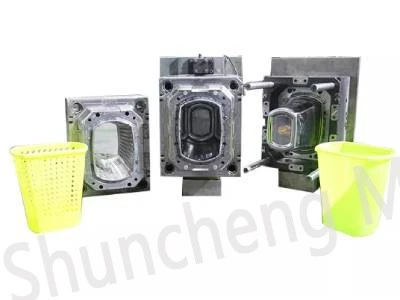
In a traditional manufacturing process, manual labor is required for tasks such as shaping, cutting, and assembling parts. These tasks are time - consuming and prone to human error. With industrial moulds, these processes are automated. For example, in the production of Household Plastic Trash Can Mould, the injection moulding machine can produce trash cans in a continuous cycle. Workers are only needed for monitoring the machine, loading raw materials, and performing quality checks.
The reduced need for manual labor also means that there are fewer opportunities for human - related errors. Automated processes using industrial moulds are more consistent and reliable, resulting in a higher - quality product with fewer defects. This further reduces costs associated with rework and product recalls.
4. Quality Control and Consistency
Industrial moulds ensure a high level of quality control and consistency in production. A well - designed mould produces parts or products that meet the exact specifications every time. This reduces the need for costly quality control measures and rework.
When parts are produced with consistent dimensions and quality, they fit together perfectly during the assembly process. This eliminates the need for adjustments and modifications, which can be time - consuming and expensive. In industries such as automotive and aerospace, where precision is crucial, the use of industrial moulds is essential.
For example, in the automotive industry, parts produced using industrial moulds must meet strict safety and performance standards. A single defective part can lead to a costly recall. By using high - quality moulds, manufacturers can ensure that each part is identical and meets all the necessary requirements. This not only saves on the cost of rework and recalls but also enhances the brand reputation, which can lead to increased customer loyalty and sales.
5. Faster Production Cycles
Industrial moulds enable faster production cycles compared to traditional manufacturing methods. The ability to produce parts or products quickly means that manufacturers can meet market demand more efficiently and reduce inventory costs.
In injection moulding, for instance, the cycle time from injecting the molten material into the mould to ejecting the finished part can be very short. This allows manufacturers to produce a large number of parts in a relatively short period. Shorter production cycles also mean that manufacturers can respond more quickly to changes in market demand. They can adjust their production volume and product mix more easily, reducing the risk of over - or under - production.
Faster production cycles also reduce the cost of holding inventory. Instead of having large stocks of finished products sitting in warehouses, manufacturers can produce products on a just - in - time basis. This frees up capital that would otherwise be tied up in inventory and reduces the risk of inventory obsolescence.
Conclusion
In conclusion, industrial moulds are a key factor in cost - reduction in production. Through economies of scale, material efficiency, reduced labor costs, quality control, and faster production cycles, they offer manufacturers a competitive edge in the market.
As an industrial mould supplier, we are committed to providing our customers with high - quality moulds that are designed to meet their specific production needs. Our team of experienced engineers and technicians uses the latest technology and manufacturing processes to ensure that our moulds are precise, durable, and efficient.
If you are looking to reduce your production costs and improve the quality of your products, we invite you to contact us for a consultation. We can work with you to develop customized mould solutions that will help you achieve your business goals.
References
- Groover, M. P. (2010). Fundamentals of Modern Manufacturing: Materials, Processes, and Systems. John Wiley & Sons.
- Throne, J. L. (2017). Injection Molding Handbook. Hanser Publications.