

Hey there! I'm a supplier of Washing Machine Moulds, and today I wanna talk about how accurate the dimensions of a washing machine mould are. It's a topic that's super important in our industry, and I've got a bunch of insights to share based on my years of experience.
First off, why are accurate dimensions so crucial for a washing machine mould? Well, think about it. A washing machine is a complex appliance made up of many parts that need to fit together perfectly. If the mould dimensions are off, even by a tiny bit, it can lead to all sorts of problems. The parts produced might not assemble correctly, which could affect the overall functionality of the washing machine. It could also lead to leaks, strange noises, or even premature wear and tear. So, getting those dimensions right is like hitting the bullseye in a target - it's the key to a high - quality end product.
Now, let's dig into how we ensure the accuracy of these dimensions. At our place, we start with state - of - the - art design software. This software allows us to create detailed 3D models of the washing machine moulds. We can specify every single dimension down to the millimeter, and it gives us a clear picture of how the final mould will look. It's like having a virtual preview before we even start the manufacturing process.
But creating a model on the computer is one thing; making a real - life mould with the same accuracy is another challenge. That's where precision machining comes in. We use advanced CNC (Computer Numerical Control) machines to cut and shape the mould. These machines are programmed with the exact dimensions from our 3D models. They can work with incredible precision, cutting through metal with a level of accuracy that's truly amazing. The CNC machines follow the programmed instructions to the letter, ensuring that each part of the mould is made to the right size.
However, even with the best technology, there are still some factors that can affect the accuracy of the dimensions. One of these factors is the material we use for the mould. Different metals have different properties, and they can expand or contract depending on the temperature. For example, if we're working with a metal that has a high coefficient of thermal expansion, it might change size slightly during the manufacturing process or when it's in use. To deal with this, we carefully select the materials based on their stability and make adjustments to our manufacturing process accordingly.
Another factor is the wear and tear that the mould goes through over time. Every time a mould is used to produce a washing machine part, it experiences a certain amount of stress. This can cause the surface of the mould to wear down, which might change its dimensions. To combat this, we regularly inspect our moulds and perform maintenance. We use high - precision measuring tools to check the dimensions of the moulds at regular intervals. If we notice any changes, we can make the necessary repairs or adjustments to keep the mould accurate.
Let's talk about some specific types of washing machine moulds. Take the Washing Machine Base Mould. The base of a washing machine is a critical part as it provides the foundation for the whole appliance. The dimensions of the base mould need to be extremely accurate to ensure that the washing machine sits level and stable. Any deviation in the dimensions could lead to the machine vibrating or moving around during operation.
The Washing Machine Injection Mould is also very important. Injection moulding is a common process used to make many of the plastic parts in a washing machine. The accuracy of the injection mould determines the shape and size of these plastic parts. If the mould dimensions are wrong, the plastic parts might not fit properly with other components in the washing machine.
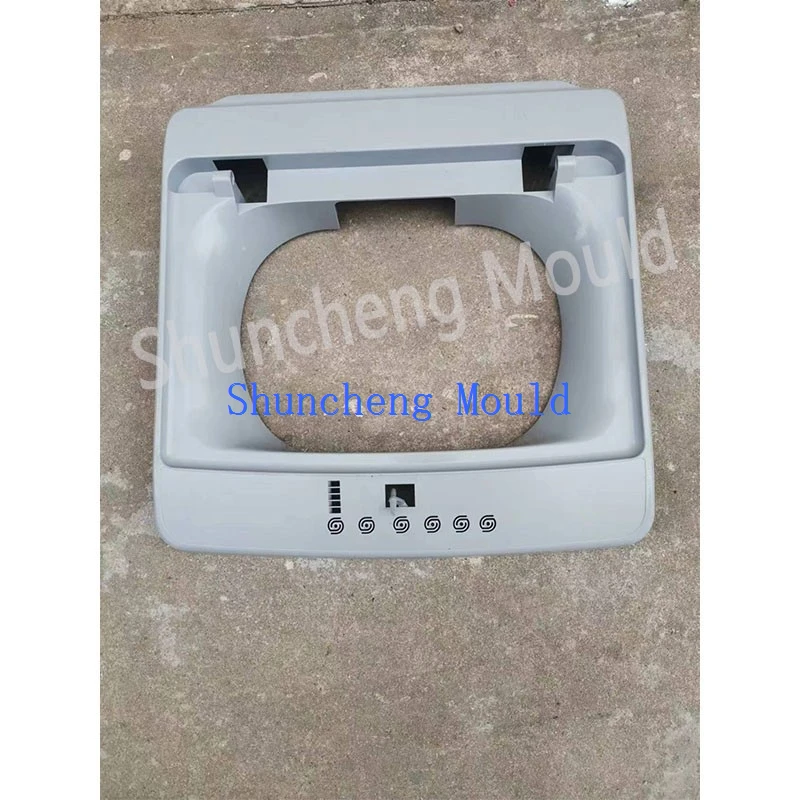
And then there's the Washing Machine Control Panel Seat Mould. The control panel is where the user interacts with the washing machine, so it needs to be precise. The mould for the control panel seat must be made with high accuracy to ensure that the control panel fits snugly and that all the buttons and displays are in the right place.
In terms of measuring the accuracy of the dimensions, we use a variety of tools. Calipers are one of the most basic but essential tools. They allow us to measure the thickness, diameter, and other linear dimensions of the mould. We also use micrometers for even more precise measurements. These tools can measure dimensions with an accuracy of up to a few thousandths of a millimeter.
For more complex shapes and 3D measurements, we use coordinate measuring machines (CMMs). These machines can measure the position of points on the surface of the mould in three - dimensional space. They're very accurate and can provide detailed information about the shape and dimensions of the mould.

So, how accurate can we really get? Well, in our experience, we can achieve an accuracy of within ±0.05mm for most of our washing machine moulds. That might not sound like much, but in the world of manufacturing, it's a huge deal. It means that the parts produced by our moulds will fit together perfectly, and the washing machines will work as they're supposed to.
But we're not stopping there. We're constantly looking for ways to improve our accuracy. We're investing in new technologies and research to find better materials and manufacturing processes. We're also training our staff to be even more skilled in using the latest tools and techniques.
If you're in the market for high - quality washing machine moulds, we'd love to hear from you. Whether you're a small - scale manufacturer or a large - scale enterprise, we can provide you with moulds that meet your specific requirements. Our commitment to accuracy and quality means that you can trust us to deliver moulds that will help you produce top - notch washing machines.
So, if you're interested in discussing your needs or getting a quote, don't hesitate to reach out. We're here to help you take your washing machine production to the next level.
References
- Manufacturing Technology Handbook, John Wiley & Sons
- Precision Machining: Principles and Applications, McGraw - Hill Education