

As a supplier of Plastic Spool Moulds, I am often asked about the technical parameters that define these essential tools in the plastic manufacturing industry. Understanding these parameters is crucial for both manufacturers and buyers, as they directly impact the quality, efficiency, and cost-effectiveness of the production process. In this blog post, I will delve into the key technical parameters of a plastic spool mould, providing insights that can help you make informed decisions when purchasing or using these moulds.
Material Selection
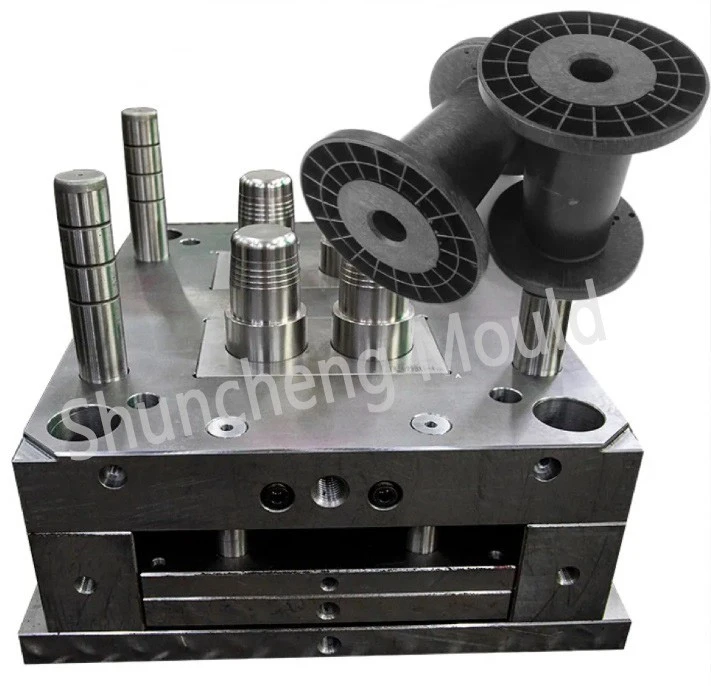
The choice of material for a plastic spool mould is fundamental, as it determines the mould's durability, heat resistance, and ability to produce high-quality plastic spools. Commonly used materials include tool steels such as P20, H13, and S7. P20 is a pre-hardened steel that offers good machinability and is suitable for low to medium production runs. H13 is a hot work steel known for its excellent thermal fatigue resistance, making it ideal for high-volume production where the mould is subjected to repeated heating and cooling cycles. S7 is a shock-resistant steel that can withstand high-impact forces, which is beneficial in applications where the mould may experience sudden stresses.
Dimensional Accuracy
Dimensional accuracy is a critical parameter in plastic spool moulds. The mould must be designed and manufactured to precise specifications to ensure that the produced plastic spools meet the required dimensions. This includes the outer diameter, inner diameter, height, and wall thickness of the spool. Even minor deviations in these dimensions can affect the functionality of the spool, such as its ability to fit properly on a winding machine or hold the correct amount of wire or cable. Advanced machining techniques, such as computer numerical control (CNC) machining, are used to achieve high levels of dimensional accuracy in mould manufacturing.
Surface Finish
The surface finish of a plastic spool mould has a significant impact on the appearance and quality of the final plastic spool. A smooth surface finish reduces friction during the ejection process, preventing the spool from sticking to the mould and minimizing the risk of surface defects. It also enhances the aesthetic appeal of the spool. Polishing and texturing are common methods used to achieve the desired surface finish. Polishing can be done to different levels of smoothness, depending on the application requirements. Texturing, on the other hand, can be used to create specific patterns or textures on the spool surface for functional or decorative purposes.
Cavity Design
The cavity design of a plastic spool mould refers to the number and arrangement of cavities within the mould. Single-cavity moulds are used for low-volume production or when high precision is required for each individual spool. Multi-cavity moulds, on the other hand, can produce multiple spools simultaneously, increasing production efficiency and reducing costs per unit. However, designing multi-cavity moulds requires careful consideration to ensure uniform filling, cooling, and ejection of the plastic in each cavity. Balanced runner systems are often used to distribute the molten plastic evenly among the cavities.
Cooling System
An efficient cooling system is essential for a plastic spool mould to ensure rapid and uniform cooling of the plastic. This helps to reduce cycle times, improve the dimensional stability of the spool, and prevent warping or shrinkage. Cooling channels are typically drilled or machined into the mould to circulate a coolant, such as water or oil. The design of the cooling channels, including their size, shape, and layout, is crucial for achieving optimal cooling performance. Computational fluid dynamics (CFD) analysis can be used to simulate the coolant flow and optimize the cooling system design.
Ejection System
The ejection system is responsible for removing the finished plastic spool from the mould after the cooling process. A reliable ejection system is necessary to prevent damage to the spool and ensure smooth production. There are several types of ejection systems, including ejector pins, ejector sleeves, and stripper plates. Ejector pins are the most commonly used method, where pins are pushed through the mould to push the spool out. Ejector sleeves are used when a more uniform ejection force is required, especially for spools with a small inner diameter. Stripper plates are used for spools with a large surface area or complex shapes.
Gate Design
The gate is the point where the molten plastic enters the mould cavity. The design of the gate has a significant impact on the filling pattern, part quality, and ease of gate removal. There are different types of gates, such as direct gates, edge gates, and submarine gates. Direct gates are simple and suitable for small parts, but they can leave a visible mark on the spool. Edge gates are commonly used for larger spools and provide a more uniform filling pattern. Submarine gates are hidden gates that are cut off automatically during the ejection process, leaving a clean finish on the spool.
Mold Flow Analysis
Mold flow analysis is a valuable tool in the design and optimization of plastic spool moulds. It uses computer simulations to predict the flow of molten plastic through the mould cavity during the injection molding process. This analysis can help identify potential issues such as air traps, weld lines, and uneven filling, allowing for adjustments to be made to the mould design before manufacturing. By optimizing the mould design based on mold flow analysis, manufacturers can improve the quality of the plastic spools and reduce production costs.
Compatibility with Injection Molding Machines
The plastic spool mould must be compatible with the injection molding machine used for production. This includes considerations such as the size of the mould, the clamping force required, and the injection pressure and speed. The mould must fit properly on the machine's platen and be able to withstand the clamping force without deformation. The injection molding machine should also be capable of providing the necessary injection pressure and speed to fill the mould cavity with molten plastic effectively.
In conclusion, the technical parameters of a plastic spool mould play a crucial role in determining its performance and the quality of the produced plastic spools. As a [Plastic Spool Mould Supplier], we understand the importance of these parameters and strive to provide high-quality moulds that meet the specific requirements of our customers. If you are interested in our Injection Plastic Spool Bobbin Mould, Plastic Cone Bobbin Mould, or Cable Spool Plastic Injection Mold, please feel free to contact us for further discussion and procurement negotiation.
References
- Throne, J. L. (1996). Plastics Processing Fundamentals. Hanser Publishers.
- Rosato, D. V., & Rosato, D. V. (2000). Injection Molding Handbook. Kluwer Academic Publishers.
- Beaumont, J. P. (2008). Injection Molding: Scientific and Numerical Approaches. Society of Plastics Engineers.