

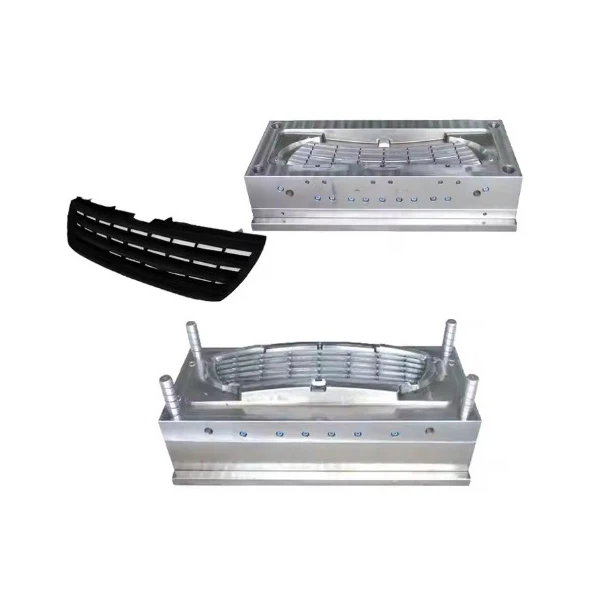
Hey there! As a supplier of Front Grille Mould, I've dealt with all sorts of challenges when it comes to front grille moulds. One of the most crucial steps in the manufacturing process is demolding. In this blog, I'm gonna share some of the common demolding methods for front grille moulds.
1. Ejection Pin Demolding
This is probably the most basic and widely - used demolding method. Ejection pins are placed inside the mould cavity. Once the plastic in the front grille has cooled and solidified to a certain extent, the ejection pins are actuated. They push the molded front grille out of the mould cavity.
The advantage of this method is its simplicity and cost - effectiveness. It's relatively easy to design and install ejection pins in the mould. However, it also has some drawbacks. Ejection pins can leave marks on the surface of the front grille. These marks might not be a big deal if the grille has a textured or rough finish, but for high - end, smooth - surfaced grilles, it can be a problem.
2. Stripper Plate Demolding
A stripper plate is a flat plate that moves parallel to the parting line of the mould. When it's time to demold, the stripper plate moves towards the molded front grille, pushing it out of the core of the mould.
This method is great for front grilles with complex shapes or undercuts. The stripper plate can provide a more uniform force distribution compared to ejection pins. That means it's less likely to cause damage to the grille during demolding. But, the design and manufacturing of a stripper plate system are more complex and expensive. You need to make sure the stripper plate moves smoothly and precisely, or it can lead to misaligned demolding.
3. Air Ejection Demolding
Air ejection uses compressed air to blow the molded front grille out of the mould. Small holes are drilled in the mould cavity, and when the air is released, it creates a force that pushes the grille out.

One of the biggest advantages of air ejection is that it doesn't leave any physical marks on the grille. This is perfect for grilles with a high - quality surface finish. Also, it can be a very fast demolding method, which is great for high - volume production. However, it requires a reliable air supply system. If the air pressure is not consistent or the holes get clogged, the demolding process can fail.
4. Hydraulic Demolding
Hydraulic systems can be used to demold front grille moulds, especially for large - sized grilles. Hydraulic cylinders are used to apply a strong and controlled force to push the grille out of the mould.
The power of hydraulic systems allows them to handle heavy and large - scale front grilles. They can provide a lot of force in a relatively small space. But, hydraulic systems are more expensive to install and maintain. There's also a risk of hydraulic fluid leakage, which can contaminate the mould and the grille.
5. Slide Core Demolding
Front grilles often have undercuts or complex features. Slide core demolding is used to deal with these situations. Slide cores are movable parts in the mould that can be retracted before demolding.
For example, if a front grille has a side - facing undercut, the slide core can be pulled back to release the undercut, and then the grille can be demolded normally. This method is very effective for creating grilles with intricate designs. However, it makes the mould design much more complex. There are more moving parts, which means more chances of mechanical failures.
6. Thermal Demolding
In some cases, thermal demolding can be used. This method takes advantage of the different thermal expansion coefficients of the mould and the plastic grille. By heating or cooling the mould in a controlled way, the plastic grille can shrink or expand relative to the mould, making it easier to demold.
This method can be very precise and can be used for grilles made of certain types of plastics. But, it requires a good understanding of the thermal properties of both the plastic and the mould material. It also needs a well - controlled heating or cooling system, which can be costly to set up.
Choosing the Right Demolding Method
When it comes to choosing the right demolding method for front grille moulds, there are several factors to consider.
1. Grille Design
If the grille has a simple design with no undercuts, ejection pin demolding might be sufficient. But for grilles with complex shapes, slide core or stripper plate demolding could be better options.
2. Surface Finish
For grilles that require a high - quality, smooth surface finish, air ejection or thermal demolding might be the way to go, as they don't leave any physical marks on the grille.
3. Production Volume
If you're producing a large number of grilles, fast demolding methods like air ejection or hydraulic demolding are more suitable. They can increase the production efficiency and reduce the overall cost per unit.
4. Cost
The cost of the demolding method includes both the initial investment in the mould design and the long - term operating costs. Ejection pin demolding is usually the cheapest option, while methods like slide core or hydraulic demolding are more expensive.
As a Front Grille Mould supplier, we have the expertise to help you choose the most appropriate demolding method for your specific needs. Whether you're looking for a Radiator Grille Mould or an Automotive Grille Injection Mould, we can provide you with high - quality moulds and professional advice.
If you're in the market for front grille moulds or have any questions about demolding methods, don't hesitate to get in touch with us. We're here to work with you to create the best front grille moulds for your production requirements.
References
- "Plastic Injection Molding Handbook" by O. Oscar Cruz
- "Mould Design and Manufacturing Technology" by Zhang Xichun