

Hey there! As a front grille mould supplier, I've seen my fair share of issues with these moulds over the years. In this blog, I'm gonna share some of the common problems that can pop up with front grille moulds.
1. Surface Defects
One of the most noticeable problems with front grille moulds is surface defects. These can include things like flow marks, sink marks, and scratches. Flow marks look like waves or streaks on the surface of the grille. They usually happen when the molten plastic doesn't flow evenly through the mould cavity. This can be due to a few reasons, like the gate location being off or the melt temperature not being right.
Sink marks are another headache. They're small depressions on the surface of the grille, often found near thick sections or ribs. When the plastic cools and shrinks, it can pull away from the mould surface in these areas, creating sink marks. Scratches, on the other hand, can occur during the ejection process or handling of the mould. If the mould surface isn't smooth enough or if there's debris in the mould, it can scratch the grille.
2. Dimensional Inaccuracy
Getting the right dimensions is crucial for front grille moulds. If the grille doesn't fit properly in the vehicle, it's a big problem. Dimensional inaccuracies can happen due to several factors. One common cause is the shrinkage of the plastic. Different types of plastics have different shrinkage rates, and if these aren't accounted for in the mould design, the final grille might be too small or too big.
Another factor is the wear and tear of the mould over time. As the mould is used repeatedly, the cavities can start to wear out, causing changes in the dimensions of the grille. Also, improper clamping force during the injection molding process can lead to dimensional variations. If the mould isn't clamped tightly enough, the plastic can leak out, resulting in an uneven grille.
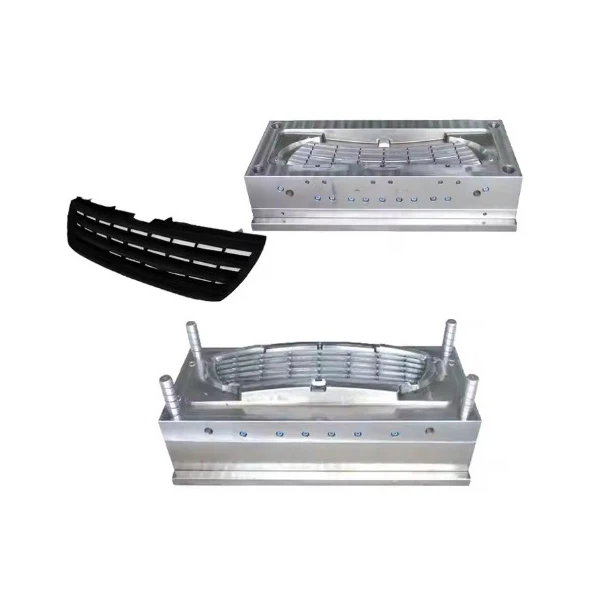

3. Gate Residue
The gate is the point where the molten plastic enters the mould cavity. Sometimes, after the injection molding process, there can be residue left at the gate area. This residue can be unsightly and can also affect the functionality of the grille. If the gate design isn't optimized, it can cause the plastic to solidify unevenly at the gate, leaving behind a rough or protruding residue.
There are different types of gates, like pin gates, submarine gates, and hot runner gates. Each type has its own advantages and disadvantages when it comes to gate residue. For example, pin gates can leave a small mark on the grille, while submarine gates can sometimes break off unevenly, leaving a jagged edge.
4. Ejection Problems
Getting the finished grille out of the mould smoothly is essential. But sometimes, ejection problems can occur. One common issue is sticking. If the grille sticks to the mould, it can be difficult to eject, and it might even get damaged in the process. Sticking can be caused by a few things, such as improper surface treatment of the mould, high friction between the grille and the mould, or incorrect ejection mechanism.
Another ejection problem is deformation. If the ejection force is too high or if the ejection pins aren't properly placed, it can cause the grille to deform. This can affect the appearance and functionality of the grille.
5. Cooling Issues
Proper cooling is crucial for the quality of the front grille. If the cooling process isn't done right, it can lead to a variety of problems. Uneven cooling can cause warping of the grille. When different parts of the grille cool at different rates, it can create internal stresses, which can lead to warping.
Also, if the cooling channels in the mould aren't designed properly, it can take a long time for the grille to cool down. This not only slows down the production process but can also affect the dimensional accuracy of the grille. The cooling channels need to be evenly spaced and sized to ensure uniform cooling.
6. Material Compatibility
The choice of plastic material for the front grille is important. Different plastics have different properties, and if the wrong material is used, it can cause problems. For example, some plastics might be too brittle, which can lead to cracking of the grille. Others might not have good heat resistance, which can be a problem if the grille is exposed to high temperatures under the hood.
Also, the material needs to be compatible with the mould. Some plastics can react with the mould surface, causing corrosion or other damage to the mould. It's important to choose a material that is suitable for the specific application of the grille and that is compatible with the mould.
Solutions and How We Can Help
At our company, we've developed several solutions to address these common problems. For surface defects, we use advanced polishing techniques to ensure a smooth mould surface. We also optimize the gate design to minimize flow marks and gate residue. When it comes to dimensional accuracy, we use precision machining and strict quality control measures to ensure that the moulds are made to the exact specifications.
We have a team of experts who can help you choose the right plastic material for your front grille, taking into account factors like durability, heat resistance, and cost. For ejection problems, we design the moulds with proper ejection mechanisms and use high - quality ejection pins to ensure smooth ejection.
We also pay close attention to the cooling system design. Our engineers use computer - aided design (CAD) and simulation software to optimize the cooling channels, ensuring uniform cooling and reducing the risk of warping.
If you're in the market for front grille moulds, whether it's an Automotive Radiator Grille Tooling Mold, an Air Conditioner Grille Mold, or a Radiator Grille Mould, we'd love to have a chat with you. We can provide you with high - quality moulds that are designed to minimize these common problems and ensure a smooth production process.
If you're interested in learning more or discussing your specific requirements, don't hesitate to reach out. We're here to help you get the best front grille moulds for your needs.
References
- Injection Molding Handbook by O. Olszewski
- Plastics Materials and Processing by James F. Carley
- Mould Design in Plastic Injection Molding by Paul A. Turner