

As a seasoned helmet mould supplier, I understand the critical importance of ensuring the performance of our products. Testing the performance of a helmet mould is not just a routine step; it's a fundamental process that guarantees the quality, safety, and efficiency of the helmets produced. In this blog, I'll share some key methods and considerations for testing the performance of a helmet mould.
1. Dimensional Accuracy Testing
Dimensional accuracy is the cornerstone of a high - quality helmet mould. A helmet must fit the wearer properly to provide effective protection. To test the dimensional accuracy of a helmet mould, we use precision measuring tools such as coordinate measuring machines (CMMs).
CMMs can measure the length, width, height, and curvature of the mould cavity with extremely high precision. By comparing the measured values with the design specifications, we can determine if the mould meets the required dimensional tolerances. For example, if the inner diameter of a helmet mould is designed to be 220mm with a tolerance of ±0.5mm, the CMM measurement should fall within this range. Any deviation beyond the tolerance can lead to ill - fitting helmets, which may compromise safety.
2. Surface Finish Testing
The surface finish of a helmet mould directly affects the appearance and smoothness of the helmets produced. A rough surface finish can cause scratches on the helmet, reduce its aesthetic appeal, and even affect the durability of the helmet's coating.
We use surface roughness testers to measure the surface finish of the mould. These testers can provide detailed information about the surface texture, such as the average roughness (Ra) and the maximum peak - to - valley height (Rz). For helmet moulds, a smooth surface finish is usually required, with an Ra value typically less than 0.8μm. This ensures that the helmets have a high - quality appearance and are free from surface defects.
3. Material Hardness Testing
The hardness of the mould material is crucial for its durability and wear resistance. A helmet mould undergoes repeated injection and ejection processes, which can cause wear and tear on the mould surface. If the material hardness is not sufficient, the mould may deform or wear out quickly, leading to a shorter service life.
We use hardness testing methods such as the Rockwell hardness test or the Brinell hardness test. These tests involve applying a specific load to the mould surface using a hardened indenter and measuring the size of the indentation. The hardness value obtained from these tests can help us determine if the mould material meets the required hardness standards. For example, for a high - quality helmet mould, the Rockwell hardness value may need to be in the range of HRC 50 - 55.

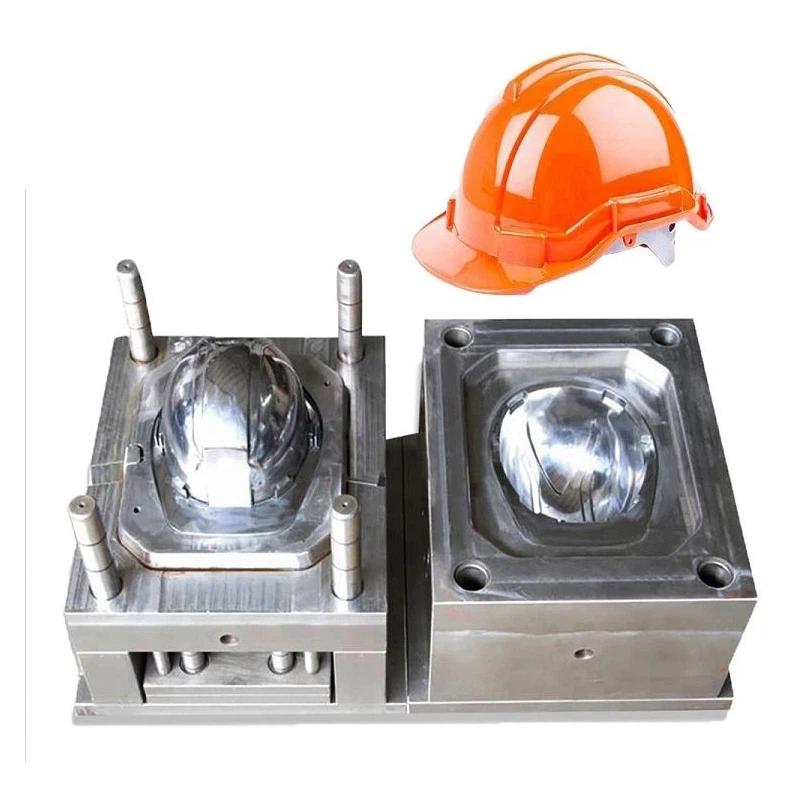
4. Injection Molding Process Simulation
Injection molding process simulation is a powerful tool for testing the performance of a helmet mould. By using specialized software, we can simulate the entire injection molding process, including the flow of molten plastic, the cooling process, and the pressure distribution inside the mould.
This simulation allows us to identify potential problems such as air traps, weld lines, and uneven cooling before the actual production. For example, if the simulation shows that there are air traps in the mould cavity, we can adjust the gate location or the injection parameters to eliminate these problems. This not only improves the quality of the helmets but also reduces the production cost and time.
5. Cycle Time Testing
Cycle time is an important indicator of the production efficiency of a helmet mould. A shorter cycle time means higher production output and lower production cost. To test the cycle time of a helmet mould, we conduct actual injection molding tests.
We record the time from the start of the injection process to the ejection of the finished helmet. By analyzing the cycle time data, we can identify the bottlenecks in the production process, such as slow cooling or long ejection times. We can then make adjustments to the mould design or the injection molding parameters to optimize the cycle time. For example, we may increase the cooling water flow rate to reduce the cooling time or improve the ejection mechanism to speed up the ejection process.
6. Ejection System Testing
The ejection system of a helmet mould is responsible for removing the finished helmet from the mould cavity. A reliable ejection system is essential for smooth production and high - quality helmets.
We conduct ejection system tests by running multiple injection molding cycles and observing the ejection process. We check if the helmet can be ejected smoothly without any damage or deformation. We also measure the ejection force using force sensors. If the ejection force is too high, it may indicate problems such as improper ejection pin design or excessive friction between the helmet and the mould cavity. In this case, we can make adjustments to the ejection system, such as changing the ejection pin layout or applying a lubricant to the mould surface.
7. Gate Design and Performance Testing
The gate is the entry point for the molten plastic into the mould cavity. The design of the gate has a significant impact on the filling pattern, the quality of the weld lines, and the overall performance of the helmet.
We use flow visualization techniques and injection molding simulations to evaluate the gate design. We also conduct actual injection molding tests to observe the filling process and the quality of the helmets produced. For example, if the gate is too small, it may cause high - pressure drops during the injection process, leading to incomplete filling or poor weld line quality. On the other hand, if the gate is too large, it may leave a large gate mark on the helmet, affecting its appearance. By optimizing the gate design, we can ensure a uniform filling pattern and high - quality helmets.
8. Cooling System Testing
The cooling system of a helmet mould plays a crucial role in controlling the temperature distribution inside the mould cavity and ensuring the proper solidification of the molten plastic. An efficient cooling system can reduce the cycle time and improve the quality of the helmets.
We use thermal imaging cameras to monitor the temperature distribution on the mould surface during the injection molding process. We also measure the cooling water temperature and flow rate to ensure that the cooling system is working effectively. If the temperature distribution is uneven, it may cause warping or shrinkage of the helmets. In this case, we can adjust the cooling channel layout or the cooling water flow rate to achieve a more uniform temperature distribution.
Why Choose Our Helmet Moulds?
Our company is committed to providing high - quality helmet moulds that meet the strictest industry standards. We use advanced testing methods and equipment to ensure the performance of our moulds. Whether you need a Helmet Injection Mold, a Safety Helmet Mould, or a Plastic Safety Helmet Mould, we have the expertise and experience to deliver the best solution for your needs.
If you are interested in our helmet moulds and would like to discuss your specific requirements, please feel free to contact us. We look forward to the opportunity to work with you and help you achieve your production goals.
References
- ASTM International. (20XX). Standards for helmet mould testing.
- Injection Molding Handbook. (20XX). John Wiley & Sons.
- Mould Design and Manufacturing Technology. (20XX). Elsevier.