

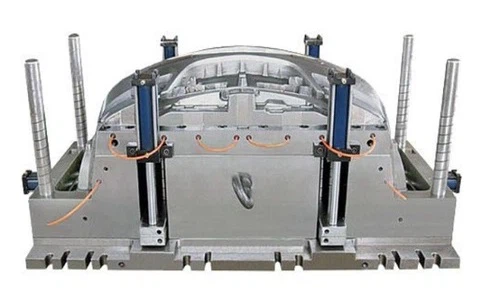
Hey there! As a rear bumper mould supplier, I've seen my fair share of problems in the production process. And let me tell you, it's not always a walk in the park. But don't worry, I'm here to share some tips on how to solve these common issues.

1. Surface Defects
One of the most common problems in rear bumper mould production is surface defects. These can include things like sink marks, flow lines, and warping. Sink marks usually occur when the plastic shrinks unevenly during the cooling process. Flow lines are caused by the way the plastic flows into the mould cavity, and warping happens when the part doesn't cool uniformly.
To solve sink marks, you can try adjusting the injection pressure and temperature. Increasing the pressure can help pack more plastic into the area prone to sinking. You can also adjust the cooling time. Sometimes, a longer cooling time allows the plastic to solidify more evenly, reducing the chance of sink marks.
For flow lines, you might need to modify the gate location. The gate is where the plastic enters the mould cavity. A better - placed gate can ensure a more uniform flow of plastic. You can also increase the melt temperature slightly to make the plastic more fluid and reduce the likelihood of flow lines.
Warping can be a bit trickier. You need to make sure the cooling system in the mould is working properly. Check for any blockages in the cooling channels and ensure that the coolant is flowing at the right rate. You might also want to consider adding some ribs or gussets to the design of the bumper to increase its stiffness and reduce warping.
2. Dimension Inaccuracies
Another big headache in rear bumper mould production is dimension inaccuracies. The bumper needs to fit perfectly on the car, so even a small deviation in dimensions can be a major problem.
One of the main causes of dimension inaccuracies is the shrinkage of the plastic. Different types of plastic have different shrinkage rates. You need to know the exact shrinkage rate of the plastic you're using and compensate for it in the mould design. This might involve making the mould slightly larger than the desired final size of the bumper.
Temperature also plays a crucial role. If the mould temperature is not consistent, the plastic will shrink differently in different areas of the bumper, leading to dimension variations. You should monitor and control the mould temperature carefully throughout the production process.
Sometimes, the clamping force of the injection moulding machine can also affect the dimensions. If the clamping force is too low, the mould might open slightly during the injection process, causing the part to have incorrect dimensions. Make sure the clamping force is set correctly according to the size and complexity of the bumper mould.
3. Ejection Problems
Ejection problems are also quite common. After the plastic has cooled and solidified in the mould, it needs to be ejected smoothly. But sometimes, the bumper gets stuck in the mould.
This can be due to several reasons. One is the surface finish of the mould. If the mould surface is too rough, the plastic will have more friction and be harder to eject. You can polish the mould surface to reduce friction.
The design of the ejector pins also matters. The ejector pins are responsible for pushing the part out of the mould. If they are not placed correctly or are too small, they might not be able to provide enough force to eject the bumper. You may need to adjust the number, size, and location of the ejector pins.
Another factor is the presence of undercuts in the bumper design. Undercuts are areas of the part that prevent it from being ejected in a straight line. If possible, try to redesign the bumper to minimize undercuts. If undercuts are necessary, you can use more complex ejection mechanisms, such as slides or lifters.
4. Material - Related Issues
The choice of plastic material can also cause problems in rear bumper mould production. Different plastics have different properties, and you need to choose the right one for the job.
Some plastics are more prone to cracking or brittleness. If you're using a plastic that is too brittle, the bumper might crack during the ejection process or when it's installed on the car. You should select a plastic with good impact resistance and flexibility.
Moisture absorption can also be an issue. Some plastics absorb moisture from the air, which can affect their properties during the injection moulding process. Before using the plastic, make sure it is properly dried. You can use a dehumidifying dryer to remove any moisture from the plastic pellets.
5. Mould Wear and Tear
Over time, the mould will experience wear and tear. This can affect the quality of the rear bumpers produced. The cavities of the mould can get worn out, leading to surface defects and dimension inaccuracies.
Regular maintenance is the key to solving this problem. You should clean the mould after each production run to remove any plastic residue or dirt. Inspect the mould regularly for signs of wear, such as scratches or erosion.
If you notice any significant wear, you can repair the mould. For minor scratches, you can polish them out. For more severe damage, you might need to use welding or other repair techniques. However, if the mould is too worn out, it might be time to replace it.
Related Products
If you're also interested in other automotive moulds, we have some great options. Check out our Car Front Bumper Mold for high - quality front bumper production. Our Compression Molds For Automotive are also a great choice for specific automotive applications. And if you need a Car Lamp Injection Mold, we've got you covered.
Conclusion
In conclusion, rear bumper mould production can be challenging, but with the right approach, you can solve these common problems. By paying attention to surface defects, dimension inaccuracies, ejection problems, material - related issues, and mould wear and tear, you can ensure a smooth production process and high - quality rear bumpers.
If you're in the market for rear bumper moulds or have any questions about the production process, feel free to reach out to us. We're always happy to help with your procurement and answer any of your queries.
References
- "Injection Molding Handbook" by O. Olufemi Ogbonna
- "Plastics Engineering Handbook" by Edward Baer