

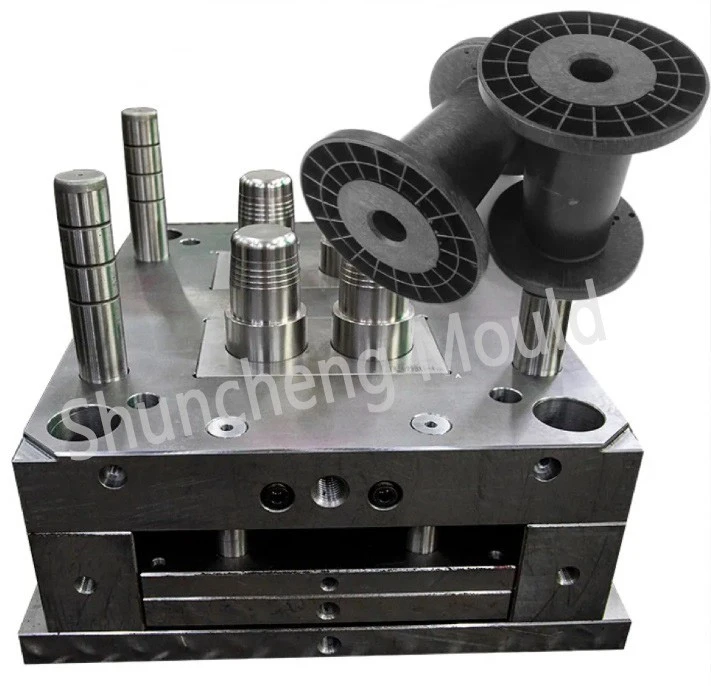
Hey there! As a plastic spool mould supplier, I've seen firsthand how crucial it is to adjust the parameters of a plastic spool mould during production. Getting these adjustments right can make a huge difference in the quality of the final product, and it's something that every manufacturer should pay close attention to. In this blog post, I'll share some tips on how to adjust the parameters of a plastic spool mould during production.
Understanding the Basics of Plastic Spool Mould Parameters
Before we dive into the adjustment process, let's quickly go over the basic parameters that you'll need to consider when working with a plastic spool mould. These include:
- Temperature: The temperature of the mould and the plastic material is crucial for proper filling and cooling. Different plastics have different melting points and processing temperatures, so it's important to set the temperature accordingly.
- Pressure: The injection pressure is used to force the molten plastic into the mould cavity. The right pressure ensures that the plastic fills the entire cavity evenly without any voids or air bubbles.
- Injection Speed: The speed at which the plastic is injected into the mould can affect the flow pattern and the quality of the final product. A too-fast injection speed may cause flashing, while a too-slow speed may result in incomplete filling.
- Cooling Time: After the plastic is injected into the mould, it needs to cool and solidify. The cooling time depends on the thickness of the part, the type of plastic, and the mould design.
Adjusting Temperature
The temperature of the mould and the plastic material is one of the most important parameters to adjust. Here's how you can do it:
- Mould Temperature: Use a temperature controller to set the mould temperature. The ideal temperature depends on the type of plastic you're using. For example, for polypropylene (PP), the mould temperature is usually between 20 - 60°C. If the mould is too cold, the plastic may solidify too quickly, leading to incomplete filling. If it's too hot, the plastic may warp or have a poor surface finish.
- Barrel Temperature: The barrel temperature controls the melting of the plastic. You need to set different temperature zones along the barrel. The rear zone is usually set at a lower temperature to prevent premature melting, while the front zone is set at a higher temperature to ensure that the plastic is fully molten when it's injected. For example, for ABS plastic, the rear zone may be set at around 180°C, and the front zone at 220 - 240°C.
Adjusting Pressure
The injection pressure needs to be adjusted based on the size and complexity of the plastic spool. Here are the steps:
- Initial Pressure Setting: Start with a relatively low pressure and gradually increase it. You can refer to the plastic material's technical data sheet for a recommended starting pressure. For a small and simple plastic spool, the initial injection pressure may be around 50 - 100 MPa.
- Monitoring the Filling Process: Observe the filling of the mould. If the plastic is not filling the entire cavity, increase the pressure slightly. But be careful not to overdo it, as too high pressure can cause flashing or damage to the mould. If you see flashing, reduce the pressure immediately.
Adjusting Injection Speed
The injection speed also plays a vital role in the production process. Here's how to adjust it:
- Slow Start: Begin with a slow injection speed to prevent the plastic from splashing or creating air bubbles at the start of the filling process. This is especially important for complex mould designs.
- Gradual Increase: As the mould starts to fill, you can gradually increase the injection speed. However, you need to monitor the process closely. If you notice any signs of uneven filling or flashing, adjust the speed accordingly.
Adjusting Cooling Time
Proper cooling time is essential for the plastic spool to have the right shape and strength. Here's how to determine the cooling time:
- Estimation Based on Thickness: A general rule of thumb is that the cooling time is proportional to the square of the part's thickness. For example, if you have a plastic spool with a thickness of 2 mm, the cooling time may be around 10 - 15 seconds. But for a thicker spool, say 5 mm, the cooling time may need to be increased to 30 - 40 seconds.
- Testing and Optimization: You can also conduct some test runs to find the optimal cooling time. Check the part after each run to see if it has cooled and solidified properly. If it's still too soft or has a distorted shape, increase the cooling time.
Troubleshooting Common Issues
Even with the right parameter adjustments, you may still encounter some issues during production. Here are some common problems and how to solve them:
- Voids or Air Bubbles: If you see voids or air bubbles in the plastic spool, it may be due to insufficient injection pressure or speed. Try increasing the pressure and adjusting the injection speed. You can also check if there are any air vents in the mould that are blocked.
- Flashing: Flashing occurs when the plastic leaks out of the mould cavity. This is usually caused by too high injection pressure or a misaligned mould. Reduce the pressure and make sure the mould is properly aligned.
- Warping: Warping can happen if the cooling is uneven or the plastic has residual stress. Check the cooling system to ensure that the plastic is cooling evenly. You may also need to adjust the mould temperature or the cooling time.
Conclusion
Adjusting the parameters of a plastic spool mould during production is a skill that requires practice and experience. By understanding the basic parameters and following the steps I've outlined above, you can improve the quality of your plastic spools and reduce production issues.
If you're in the market for high - quality plastic spool moulds, we've got you covered. We offer a wide range of products, including Cable Spool Plastic Injection Mold, Cable Spool Mould, and Injection Plastic Spool Bobbin Mould. If you're interested in our products or have any questions about plastic spool mould parameter adjustment, don't hesitate to reach out. We're here to help you with your production needs.
References
- "Plastic Injection Molding Handbook" by O. Osswald and T. Turng
- Technical data sheets of common plastic materials from major plastic manufacturers