

Customizing a grille mould is a complex process that involves multiple factors influencing the final cost. As a seasoned grille mould supplier, I've witnessed firsthand the diverse requirements and budget considerations of our clients. In this blog, I'll break down the key elements that contribute to the cost of customizing a grille mould and provide insights to help you make informed decisions.
Material Selection
The choice of material for the grille mould is a fundamental factor in determining its cost. High - quality materials are essential for ensuring the durability, precision, and longevity of the mould. Common materials used in grille mould manufacturing include tool steel, aluminum, and stainless steel.
Tool steel is a popular choice due to its excellent hardness, wear resistance, and heat resistance. It can withstand the high pressures and temperatures involved in the injection molding process. However, tool steel is relatively expensive, and the cost can vary depending on the grade and quality. For example, premium grades of tool steel with enhanced properties may cost significantly more than standard grades.
Aluminum, on the other hand, is a lightweight and cost - effective alternative. It has good thermal conductivity, which can lead to faster cycle times in the molding process. Aluminum is also easier to machine, reducing the overall manufacturing cost. But it may not be as durable as tool steel, especially for high - volume production runs.
Stainless steel offers corrosion resistance, which is crucial for applications where the grille will be exposed to harsh environments. The cost of stainless steel lies between tool steel and aluminum, and its price can be affected by factors such as the alloy composition and finish.

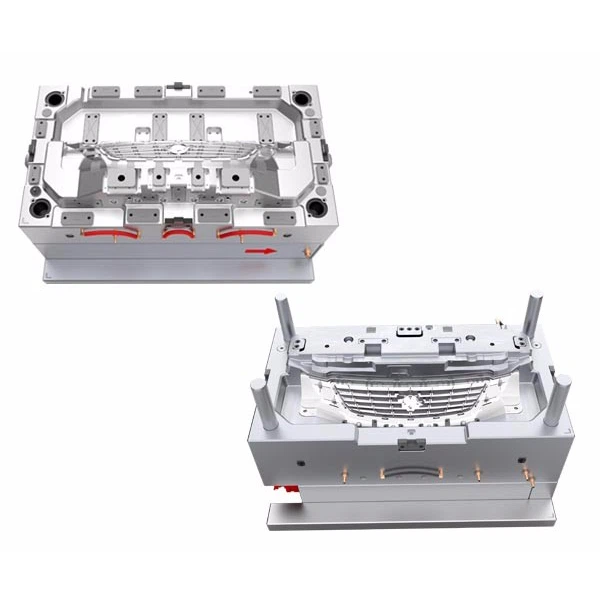
Design Complexity
The complexity of the grille design has a substantial impact on the cost of the mould. A simple, straightforward grille design with basic shapes and minimal details will generally be less expensive to manufacture than a highly intricate design.
Complex designs may require advanced machining techniques, such as electrical discharge machining (EDM) or multi - axis milling. These processes are more time - consuming and require specialized equipment and skilled operators, all of which contribute to higher costs.
For instance, a grille with a unique pattern, complex curves, or undercuts will demand more precise machining and additional steps in the manufacturing process. Undercuts, in particular, often require the use of slides or lifters in the mould design, which adds to the complexity and cost.
Mould Size
The physical size of the grille mould is another important cost determinant. Larger moulds require more material, longer machining times, and may need more powerful injection molding machines to operate. As a result, they are generally more expensive than smaller moulds.
When calculating the cost based on size, not only the external dimensions of the mould but also the internal cavity size matters. A larger cavity means more material needs to be removed during the machining process, increasing the time and cost.
In addition, handling and shipping larger moulds can also be more challenging and costly. Specialized equipment may be required to move and transport large moulds safely, adding to the overall expense.
Production Volume
The expected production volume of the grille is a key consideration in mould cost. For low - volume production, the cost per part may be higher because the initial investment in the mould needs to be amortized over a smaller number of units.
On the other hand, high - volume production allows for the spreading of the mould cost over a large number of parts, reducing the cost per unit. However, for high - volume production, the mould needs to be more robust and durable to withstand the repeated use. This may require the use of higher - quality materials and more sophisticated manufacturing processes, which can increase the upfront cost of the mould.
Surface Finish
The desired surface finish of the grille can also affect the cost of the mould. A smooth, polished surface finish is often required for aesthetic reasons, especially for automotive grilles. Achieving a high - quality surface finish may involve additional processes such as polishing, plating, or texturing.
Polishing is a labor - intensive process that requires skilled workers to ensure a uniform and smooth surface. Plating can add a layer of protection or enhance the appearance of the grille but adds to the cost due to the materials and equipment involved. Texturing, which can create unique visual effects, also requires specialized techniques and may increase the manufacturing time and cost.
Quality and Tolerance Requirements
Tight tolerances and high - quality standards are often necessary for grille moulds, especially in industries such as automotive and aerospace. Meeting these requirements demands more precise machining, better quality control, and higher - grade materials.
The cost of inspection and testing also increases with stricter quality and tolerance requirements. Advanced measurement tools and techniques, such as coordinate measuring machines (CMM), may be needed to ensure that the mould meets the specified tolerances. Any deviations from the required dimensions may result in rework, which adds to the overall cost.
Examples of Grille Mould Costs
To give you a better idea of the cost range, let's consider some examples. A simple, small - sized aluminum grille mould for a low - volume production of air conditioner grilles may cost around $5,000 - $10,000. This type of mould would have a relatively straightforward design and basic surface finish.
For a medium - sized automotive front grille mould made of tool steel with a moderately complex design, the cost could range from $20,000 - $50,000. This mould would need to meet strict quality and tolerance requirements due to the automotive industry standards.
A large - scale, highly complex automotive grille injection mould with advanced features and a high - quality surface finish could cost upwards of $100,000. Such a mould would be designed for high - volume production and would require state - of - the - art manufacturing techniques.
Our Services as a Grille Mould Supplier
As a grille mould supplier, we offer a wide range of services to meet your specific needs. We have extensive experience in designing and manufacturing various types of grille moulds, including Automotive Grille Injection Mould, Front Grille Mould, and Air Conditioner Grille Mold.
Our team of experts will work closely with you from the initial design stage to ensure that the mould meets your requirements and budget. We use the latest technology and manufacturing processes to produce high - quality moulds at competitive prices.
We also provide after - sales support, including maintenance and repair services, to ensure the long - term performance of your grille mould. Whether you are a small business looking for a cost - effective solution for low - volume production or a large corporation in need of high - volume, high - quality moulds, we have the expertise and resources to serve you.
Contact Us for a Quote
If you are interested in customizing a grille mould, we encourage you to contact us for a detailed quote. Our sales team will be happy to discuss your project requirements, answer your questions, and provide you with an accurate cost estimate. We believe in transparent pricing and will work with you to find the best solution that meets your needs and budget.
References
- "Injection Molding Handbook" by O. Olkun and A. Altan
- "Tool and Manufacturing Engineers Handbook" published by Society of Manufacturing Engineers