

As a seasoned grille cover mould supplier, I often get asked about the time it takes to manufacture a grille cover mould. The answer isn't straightforward, as it depends on multiple factors that influence the overall production timeline. In this blog, I'll delve into these factors and provide a comprehensive overview of the timeframes involved in grille cover mould manufacturing.
Factors Affecting Manufacturing Time
Design Complexity
The complexity of the grille cover design is one of the most significant factors determining the manufacturing time. A simple, straightforward grille cover with basic shapes and minimal detailing can be designed and manufactured relatively quickly. On the other hand, a grille cover with intricate patterns, fine details, and complex geometries will require more time for both design and production.
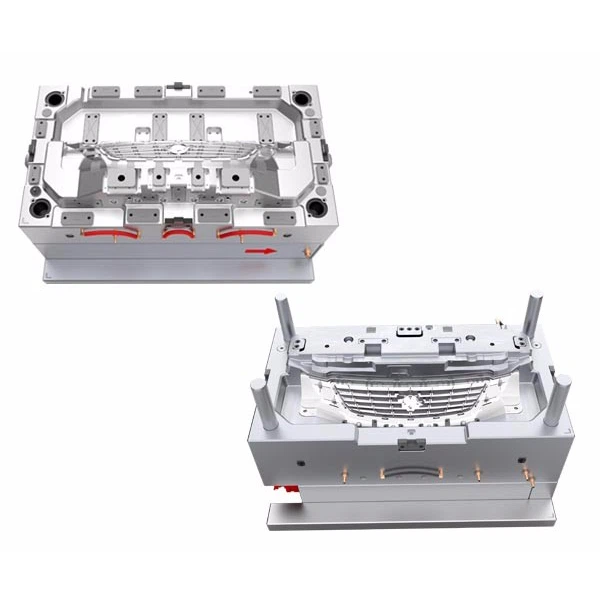
For instance, a Automotive Grille Injection Mould for a high - end luxury car often has a very elaborate design. The designers need to ensure that every curve and detail is perfect, which can take weeks or even months. They use advanced CAD/CAM software to create a 3D model of the grille cover, and multiple rounds of revisions may be required to meet the client's specifications.
Material Selection
The choice of material for the grille cover mould also impacts the manufacturing time. Different materials have different properties, such as hardness, thermal conductivity, and machinability. Common materials used for grille cover moulds include steel, aluminum, and some special alloys.
Steel is a popular choice due to its high strength and durability. However, machining steel can be time - consuming, especially if high - precision is required. Aluminum, on the other hand, is easier to machine, which can reduce the manufacturing time. But it may not be suitable for all applications, especially those that require high - wear resistance. For example, an Air Conditioner Grille Mold may use aluminum if the production volume is relatively low and the wear requirements are not too strict.
Manufacturing Process
There are several manufacturing processes involved in making a grille cover mould, such as milling, turning, EDM (Electrical Discharge Machining), and polishing. Each process has its own time requirements.
Milling is used to remove material from the block to create the basic shape of the mould. The time taken for milling depends on the size and complexity of the part. Turning is used for cylindrical features, and EDM is used for creating complex shapes and fine details that cannot be achieved by traditional machining methods. Polishing is the final step to ensure a smooth surface finish, and it can be a time - consuming process, especially for large - scale moulds.
Production Volume
The number of grille cover moulds to be produced also affects the overall manufacturing time. If it's a single - piece production, the setup time for each process may be relatively high compared to mass production. In mass production, the processes can be optimized, and the production line can be set up for efficient operation. For example, if a client orders a Front Grille Mould for a new car model, and they need multiple moulds for different production lines, the manufacturing time per mould may be reduced due to economies of scale.
Typical Timeframes
Design Phase
The design phase usually takes anywhere from 1 to 4 weeks. For a simple grille cover design, it may take about a week. The designer will create a 2D drawing and a 3D model of the grille cover, and then conduct a feasibility study to ensure that the design can be manufactured. For complex designs, especially those with unique features and high - end finishes, the design phase can take up to 4 weeks or more.
Material Procurement
Material procurement can take 1 to 2 weeks, depending on the availability of the material. If the material is a standard grade and readily available in the market, it may take only a week. However, if it's a special alloy or a custom - made material, it may take up to 2 weeks or longer.
Machining and Manufacturing
The machining and manufacturing phase is the most time - consuming part. For a simple grille cover mould, it may take 2 to 4 weeks. This includes all the machining processes such as milling, turning, and EDM. For a complex mould, it can take 6 to 10 weeks or even longer. The more intricate the design and the higher the precision requirements, the longer the machining time.
Testing and Quality Assurance
After the mould is manufactured, it needs to be tested to ensure that it meets the quality standards. This phase usually takes 1 to 2 weeks. The mould is tested for dimensional accuracy, surface finish, and functionality. Any issues found during the testing phase need to be corrected, which may add some additional time to the overall manufacturing process.

Total Manufacturing Time
Based on the above factors, the total time to manufacture a grille cover mould can range from 4 to 18 weeks. A simple grille cover mould with a basic design and standard materials can be manufactured in about 4 to 6 weeks. A complex grille cover mould with an elaborate design, special materials, and high - precision requirements may take 12 to 18 weeks or more.
Conclusion
Manufacturing a grille cover mould is a complex process that involves multiple steps and factors. The time it takes to manufacture a grille cover mould can vary significantly depending on the design complexity, material selection, manufacturing process, and production volume. As a grille cover mould supplier, we work closely with our clients to understand their requirements and provide them with an accurate timeline for the project.
If you are in the market for a high - quality grille cover mould, we are here to assist you. Our team of experienced designers and engineers can ensure that your grille cover mould is designed and manufactured to the highest standards. Contact us today to discuss your project requirements and start the procurement process.
References
- "Mould Design and Manufacturing Handbook", John Wiley & Sons
- "Advanced Manufacturing Technologies for Automotive Parts", Elsevier