

Hey there! As a front bumper mould supplier, I often get asked about the shrinkage rate of a front bumper mould. It's a crucial topic because the shrinkage rate can significantly impact the quality and fit of the final front bumper product. So, let's dive right into it and explore what this shrinkage rate is all about.
First off, what exactly is the shrinkage rate? In simple terms, it's the percentage by which a plastic part shrinks as it cools and solidifies after being injected into the mould. When we're making front bumpers, we use injection moulding most of the time. We heat up the plastic pellets until they turn into a molten state, then inject this hot plastic into the front bumper mould. As the plastic cools down, it contracts, and that's where shrinkage happens.
Now, why does this shrinkage matter? Well, if the shrinkage rate isn't properly accounted for, the front bumper might not fit correctly on the car. It could be too small or have warping issues, which are big no - no's in the automotive industry. A poorly fitting bumper can affect the car's aesthetics and even its safety features.
There are several factors that influence the shrinkage rate of a front bumper mould. One of the main factors is the type of plastic used. Different plastics have different shrinkage characteristics. For example, polypropylene (PP), which is commonly used for front bumpers, has a relatively high shrinkage rate compared to some other plastics. PP can shrink anywhere from 1.0% to 2.5% depending on the specific grade and processing conditions. On the other hand, acrylonitrile butadiene styrene (ABS) has a lower shrinkage rate, usually around 0.4% - 0.7%.
The design of the front bumper mould also plays a huge role. The thickness of the bumper walls is a key aspect. Thicker walls tend to shrink more than thinner ones because they take longer to cool. If the wall thickness isn't uniform throughout the bumper, it can lead to uneven shrinkage and cause the bumper to warp. The shape of the mould is another factor. Complex shapes with undercuts or sharp corners can cause uneven cooling and, as a result, inconsistent shrinkage.
Processing conditions during the injection moulding process are equally important. The temperature of the molten plastic, the injection pressure, and the cooling time all affect the shrinkage rate. If the plastic is injected at too high a temperature, it might cool down more slowly, leading to more shrinkage. Similarly, if the injection pressure is too low, the plastic might not fill the mould properly, and the resulting part could have voids or uneven density, which can also impact shrinkage.
To accurately determine the shrinkage rate of a front bumper mould, we usually rely on a combination of experience, testing, and simulation software. Over the years, we've built up a wealth of knowledge about how different plastics behave under various conditions. We also conduct test runs with small - scale moulds to get a better understanding of the shrinkage characteristics. And simulation software has become an invaluable tool. It can predict how the plastic will flow, cool, and shrink inside the mould, allowing us to make adjustments to the mould design and processing parameters before the full - scale production begins.
As a front bumper mould supplier, we take the shrinkage rate very seriously. We work closely with our customers to understand their specific requirements for the front bumper, including the type of plastic they want to use and the design specifications. Based on this information, we design the mould in such a way that we can compensate for the expected shrinkage.
For instance, if we know that a particular plastic has a shrinkage rate of 1.5%, we'll design the mould slightly larger than the final desired size of the bumper. This way, when the plastic shrinks during cooling, the final bumper will be the right size. We also use advanced machining techniques to ensure that the mould is made with high precision, so that the shrinkage compensation is as accurate as possible.
Now, let's talk a bit about our other related products. We also offer Bumper Injection Mould, which is a great option for high - volume production of front bumpers. These injection moulds are designed to be durable and efficient, ensuring consistent quality in every part.
In addition, we have Compression Molds For Automotive. Compression moulding can be a good alternative for certain types of front bumper production, especially when dealing with materials that are better suited for this process.
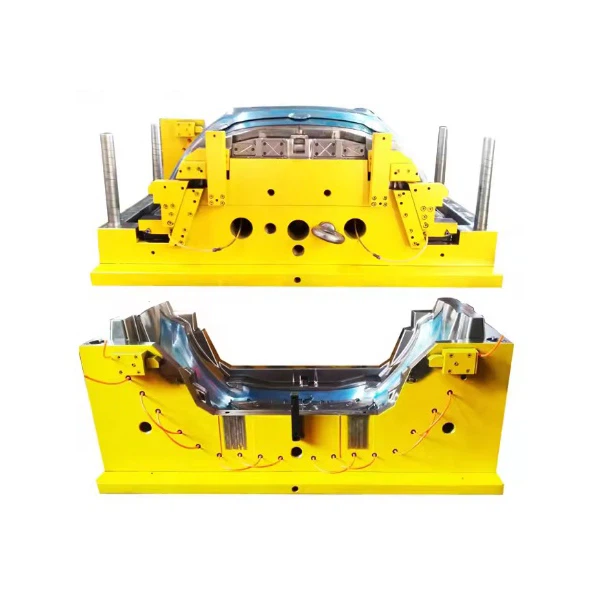

And of course, we can't forget about our Rear Bumper Mould. Just like the front bumper mould, the rear bumper mould also needs to account for shrinkage to ensure a perfect fit on the car.
If you're in the market for high - quality front bumper moulds or any of our other related products, we'd love to hear from you. Whether you're an automotive manufacturer looking to upgrade your production line or a new player in the industry, we have the expertise and the resources to meet your needs. We can provide you with detailed information about the shrinkage rate and how we design our moulds to compensate for it. So, don't hesitate to reach out and start a conversation about your front bumper mould requirements.
References
- "Injection Molding Handbook" by O. Olszewski
- "Plastics Processing: Modeling and Simulation" by A. B. Strong