

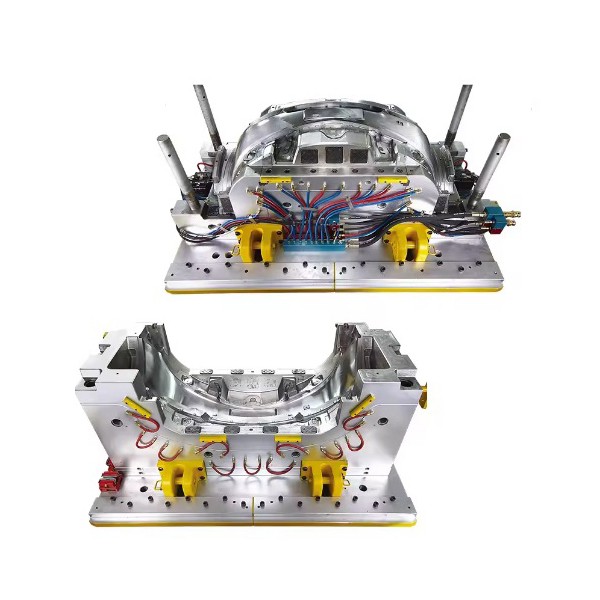
In the highly competitive automotive industry, front bumper moulds play a crucial role in the production of high - quality front bumpers. As a front - line supplier of Front Bumper Mould, we are well - acquainted with the various problems that can arise in the manufacturing process of these moulds and have developed effective solutions. In this blog post, we will explore the common problems of front bumper moulds and the strategies to address them.
Common Problems with Front Bumper Moulds
Surface Defects
One of the most frequently encountered issues is surface defects on the front bumpers produced by the moulds. These defects can include scratches, pitting, and orange - peel effects. Scratches may occur during the demoulding process if the mould surface is not smooth or if there is improper handling of the parts. Pitting can be caused by impurities in the plastic material or problems with the cooling system, which leads to uneven solidification. The orange - peel effect, characterized by a rough, textured surface similar to an orange peel, is often due to incorrect injection parameters such as low injection speed, high melt temperature, or improper mould temperature control.
Dimensional Inaccuracies
Dimensional accuracy is of utmost importance for front bumpers as they need to fit precisely onto the vehicle. Inaccuracies can occur in the length, width, height, or curvature of the bumper. This can be a result of mould wear over time, incorrect mould design, or problems with the injection moulding equipment. For example, if the mould cavity has been eroded due to repeated use, the dimensions of the produced bumpers will gradually deviate from the design specifications. In addition, improper clamping force during the injection process can cause the mould to deform slightly, resulting in dimensional errors.
Warping and Deformation
Warping is another significant problem in front bumper manufacturing. It occurs when the bumper cools unevenly after injection moulding, causing internal stresses that lead to a distorted shape. This can be due to improper cooling channel design in the mould, unequal wall thickness of the bumper, or incorrect gating system. When the cooling channels are not evenly distributed, some areas of the bumper will cool faster than others, leading to differential shrinkage and warping. Unequal wall thickness can also cause uneven cooling, as thicker sections take longer to cool and solidify compared to thinner ones.
Short Shots
Short shots happen when the plastic material does not completely fill the mould cavity during the injection process. This can be caused by insufficient injection pressure, clogged gates or runners, or incorrect melt viscosity. If the injection pressure is too low, the plastic may not be able to flow to all parts of the mould. Clogged gates or runners can block the flow path of the plastic, preventing it from reaching the far - end of the cavity. Incorrect melt viscosity, either too high or too low, can also affect the flowability of the plastic and result in short shots.
Solutions to Front Bumper Mould Problems
Addressing Surface Defects
To eliminate scratches, it is essential to ensure the mould surface is properly polished. Regular maintenance and cleaning of the mould can remove any debris or contaminants that may cause scratches during demoulding. Using release agents can also reduce friction between the bumper and the mould, minimizing the risk of scratches.

For pitting, improving the quality of the plastic material is crucial. Conducting thorough inspections of the raw materials before use can help identify and remove any impurities. Additionally, optimizing the cooling system is necessary. Ensuring that the cooling channels are unobstructed and the coolant flow rate is consistent can promote uniform solidification and reduce the occurrence of pitting.
To prevent the orange - peel effect, adjusting the injection parameters is key. Increasing the injection speed can help the plastic flow more smoothly and fill the mould evenly. Selecting an appropriate melt temperature and maintaining a stable mould temperature can also improve the surface finish of the bumpers.
Correcting Dimensional Inaccuracies
To deal with dimensional inaccuracies, regular inspection and maintenance of the mould are necessary. Periodically checking the dimensions of the mould cavity using precision measuring tools can help detect any signs of wear early. If wear is detected, re - machining or replacing the worn components of the mould can restore its dimensional accuracy.
Improving the mould design is also important. Using advanced computer - aided design (CAD) software can help optimize the mould structure and ensure that the design is accurate and error - free. Additionally, calibrating the injection moulding equipment regularly and ensuring proper clamping force can prevent mould deformation during the injection process.
Resolving Warping and Deformation
When it comes to warping and deformation, redesigning the cooling channel system is often necessary. The cooling channels should be evenly distributed around the mould cavity to ensure uniform cooling of the bumper. Using simulation software can help analyze the cooling process and optimize the channel design.
Balancing the wall thickness of the bumper is also crucial. Designing the part with a more uniform wall thickness can minimize the differential shrinkage during cooling. In addition, adjusting the gating system can improve the flow of the plastic material and reduce the internal stresses that cause warping.
Avoiding Short Shots
To prevent short shots, increasing the injection pressure can be a simple yet effective solution. However, it is important to ensure that the increased pressure does not cause other problems such as flash or excessive wear on the mould. Unclogging the gates and runners regularly can also ensure smooth plastic flow. If the melt viscosity is incorrect, adjusting the temperature of the plasticizing unit can help achieve the optimal viscosity for injection.
The Role of Advanced Technologies in Solving Mould Problems
In addition to the traditional solutions mentioned above, advanced technologies are playing an increasingly important role in solving front bumper mould problems. For instance, the use of 3D printing technology can help in rapid prototyping of moulds. This allows for quick design verification and modification, reducing the time and cost associated with traditional mould - making processes. 3D - printed moulds can also have complex internal structures, such as conformal cooling channels, which can significantly improve the cooling efficiency and reduce warping and deformation.
Artificial intelligence (AI) and machine learning algorithms can be applied to monitor and optimize the injection moulding process. These technologies can analyze real - time data from sensors installed in the mould and the injection moulding machine, such as temperature, pressure, and flow rate. By detecting patterns and predicting potential problems, AI can automatically adjust the process parameters to ensure consistent quality of the front bumpers.
Our Expertise as a Front Bumper Mould Supplier
As a professional Front Bumper Mould supplier, we have a team of experienced engineers and technicians who are well - versed in solving the problems associated with front bumper moulds. We use state - of - the - art manufacturing equipment and technologies to ensure the high quality and precision of our moulds.
We offer comprehensive services, including mould design, manufacturing, and after - sales support. Our design team uses the latest CAD/CAM software to create customized moulds that meet the specific requirements of our customers. During the manufacturing process, we strictly follow quality control procedures to ensure that every mould meets the highest standards.
In addition to front bumper moulds, we also supply Compression Molds For Automotive and Rear Bumper Mould. Our wide range of products and services make us a one - stop solution for automotive bumper mould needs.
Conclusion
Solving the problems of front bumper moulds requires a comprehensive approach that includes understanding the common issues, implementing effective solutions, and leveraging advanced technologies. As a reliable front bumper mould supplier, we are committed to providing high - quality moulds and excellent customer service. If you are facing challenges with front bumper moulds or are looking for a new supplier, we invite you to contact us for a detailed discussion. We are confident that our expertise and experience can help you overcome any problems and achieve your production goals.
References
- "Injection Moulding Handbook" by O. Olajide
- "Automotive Mould Design and Manufacturing" by J. Smith
- Research papers on advanced manufacturing technologies in the automotive industry from academic databases