

Hey there! As a front bumper mould supplier, I often get asked about how to calculate the clamping force for a front bumper mould. It's a crucial aspect in the injection - moulding process, and getting it right can make or break your production. So, let's dive right into it!
Understanding Clamping Force
First things first, what the heck is clamping force? Well, clamping force is the amount of force that the injection - moulding machine applies to keep the two halves of the mould closed during the injection process. When molten plastic is injected into the mould cavity, it exerts pressure on the mould walls. If the clamping force isn't sufficient, the mould can open slightly, causing flash (excess plastic that seeps out of the mould).
Factors Affecting Clamping Force
There are several factors that come into play when calculating the clamping force for a front bumper mould.
Mould Cavity Pressure
The pressure inside the mould cavity during injection is a major factor. This pressure depends on the type of plastic material being used. Different plastics have different flow characteristics, and some require higher injection pressures to fill the mould cavity properly. For example, engineering plastics like polycarbonate usually need higher pressures compared to more common plastics like polyethylene.
Projected Area of the Mould
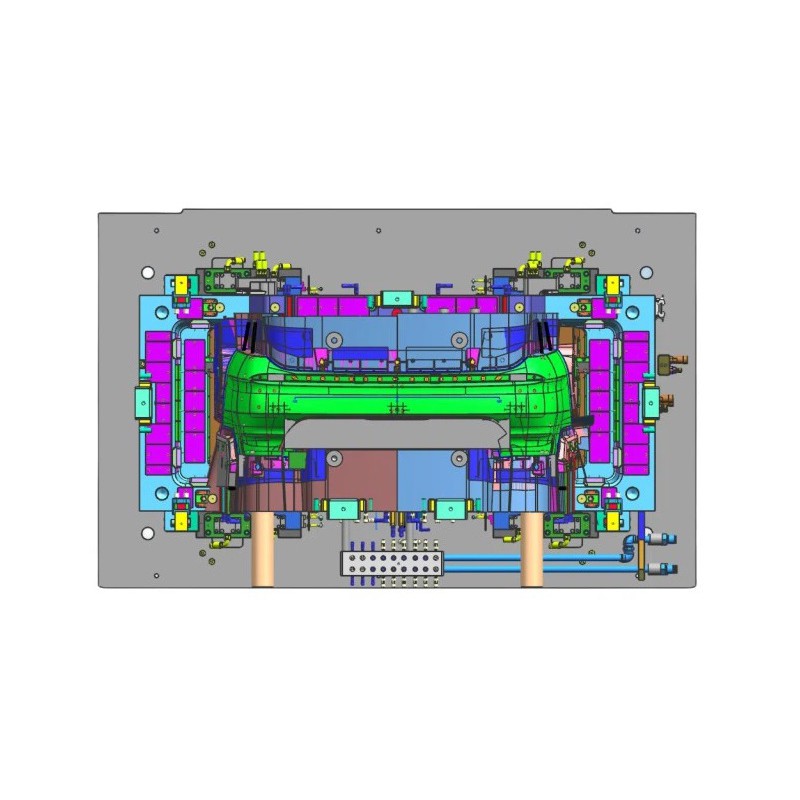
The projected area of the front bumper in the parting plane of the mould is another crucial factor. The larger the projected area, the more clamping force is required. Think of it like this: if you have a bigger surface area for the molten plastic to push against, you need more force to keep the mould closed. You can calculate the projected area by measuring the length and width of the bumper in the parting plane and multiplying them.
Number of Cavities
If your mould has multiple cavities (meaning it can produce multiple front bumpers in one cycle), you'll need to account for that. The clamping force required will increase with the number of cavities because there's more plastic being injected and more pressure being exerted on the mould.
The Calculation Process
Now, let's get to the actual calculation. There's a simple formula that can give you a rough estimate of the clamping force:
Clamping Force (F) = Projected Area (A) × Cavity Pressure (P)
First, measure the projected area of the front bumper in square inches or square centimeters. Make sure to measure it in the parting plane of the mould. Then, you need to determine the cavity pressure. You can find typical cavity pressure values for different plastic materials in engineering handbooks or from plastic resin suppliers.
For example, let's say the projected area of your front bumper mould is 500 square inches, and the cavity pressure for the plastic you're using is 2000 pounds per square inch (psi). Using the formula, the clamping force would be:
F = A × P
F = 500 in² × 2000 psi
F = 1,000,000 pounds

However, in real - world applications, you need to add a safety factor. A safety factor of 1.2 to 1.5 is commonly used. This accounts for any variations in the injection process, such as changes in plastic viscosity or fluctuations in injection pressure. So, if we use a safety factor of 1.3, the actual clamping force required would be:
Actual Clamping Force = 1,000,000 pounds × 1.3 = 1,300,000 pounds
Importance of Accurate Clamping Force Calculation
Getting the clamping force right is super important. If the clamping force is too low, as I mentioned earlier, you'll end up with flash. Flash not only affects the appearance of the front bumper but also requires additional finishing work, which adds to the production cost and time.
On the other hand, if the clamping force is too high, it can put unnecessary stress on the mould and the injection - moulding machine. This can lead to premature wear and tear of the mould components and may even cause damage to the machine.
Other Related Moulds
As a front bumper mould supplier, we also deal with other types of automotive moulds. If you're interested in Rear Bumper Mould, we've got you covered. Rear bumper moulds have similar considerations when it comes to clamping force calculation, but the projected area and shape may be different.
We also offer Car Lamp Injection Mold. These moulds require high precision as car lamps have complex shapes and optical requirements. The clamping force calculation for car lamp injection molds also depends on the plastic material and the projected area of the lamp.
And for those in need of Compression Molds For Automotive, we have the expertise to provide high - quality products. Compression molding has a different process compared to injection molding, but clamping force is still an important consideration.
Conclusion and Call to Action
Calculating the clamping force for a front bumper mould is a critical step in the injection - moulding process. It requires careful consideration of factors like mould cavity pressure, projected area, and the number of cavities. By getting it right, you can ensure high - quality production, reduce costs, and increase the lifespan of your mould and injection - moulding machine.
If you're in the market for front bumper moulds or any of our other automotive mould products, don't hesitate to reach out. We're here to help you with all your moulding needs. Whether you need advice on clamping force calculation or want to discuss your specific project requirements, we're just a message away.
References
- "Injection Molding Handbook" by O. Olsson
- Plastics Resin Technical Data Sheets from major plastic suppliers