

Hey there! As a grille cover mould supplier, I often get asked this question: Can a grille cover mould be used for making grille covers with different patterns? Well, let's dive right into it and find out.
First off, let's understand what a grille cover mould is. It's a tool that's used to shape and form grille covers. These moulds are typically made from high - quality materials like steel or aluminum, which can withstand the high pressures and temperatures involved in the manufacturing process.
Now, the short answer to whether a grille cover mould can be used for different patterns is... it depends. There are a few factors we need to consider.
Design Complexity
Some grille cover patterns are relatively simple. For example, a basic rectangular grille with evenly spaced bars. A mould designed for this type of simple pattern can sometimes be modified to create slightly different versions. Maybe you can adjust the spacing between the bars or change the thickness a bit.
However, if you're talking about going from a simple pattern to a highly complex one, like a detailed logo or an elaborate geometric design, it's a different story. Complex patterns often require a whole new set of cavities and features in the mould. For instance, a Air Conditioner Grille Mold might have a simple, functional design, but if you want to add a brand - specific logo to it, the mould will likely need significant alterations or even a complete replacement.

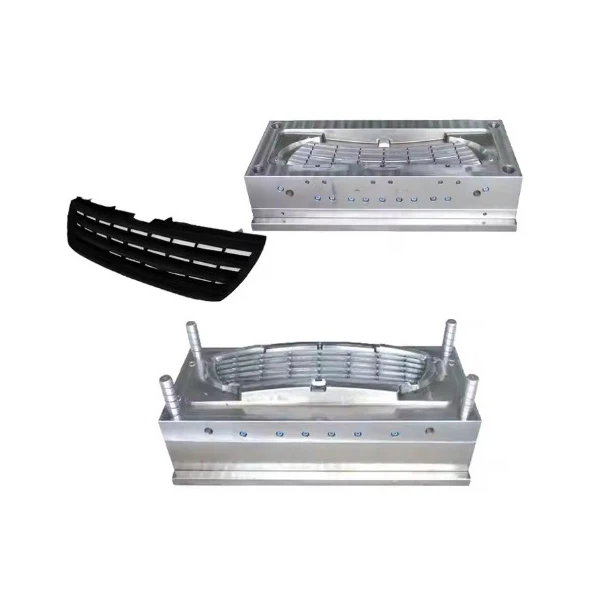
Mould Type
There are different types of grille cover moulds, such as single - cavity and multi - cavity moulds. Single - cavity moulds are designed to produce one grille cover at a time. They're often used for custom or low - volume production. If you have a single - cavity mould, it might be more feasible to make minor pattern changes. You can use techniques like engraving or etching on the mould surface to create different patterns.
On the other hand, multi - cavity moulds are used for high - volume production. They have multiple cavities that can produce several grille covers simultaneously. Changing the pattern in a multi - cavity mould can be more challenging. You need to ensure that all the cavities are modified consistently to maintain the quality and uniformity of the produced grille covers. A Radiator Grille Mould used in mass - production might be a multi - cavity type, and altering the pattern could be a costly and time - consuming process.
Material Compatibility
The material used to make the grille cover also plays a role. Different materials have different flow properties during the injection moulding process. If you want to change the pattern and also switch to a different material, it can complicate things further. Some materials might require specific mould surface finishes or temperature controls to achieve the desired pattern. For example, a Automotive Radiator Grille Tooling Mold used with a certain type of plastic might not work as well if you suddenly switch to a more brittle or viscous material while trying to change the pattern.
Cost - Benefit Analysis
When considering using a grille cover mould for different patterns, you have to do a cost - benefit analysis. Modifying a mould can be expensive. It involves machining, labor, and testing. If the cost of modification is close to or higher than the cost of making a new mould, it might be more practical to just get a new one.
On the other hand, if the pattern changes are minor and the volume of production is high, the cost of modification can be spread out over a large number of grille covers. This can make it a more cost - effective option.
The Process of Modifying a Mould
If you decide to modify a grille cover mould for a different pattern, here's what the process might look like. First, you need to have a detailed design of the new pattern. Then, the mould is inspected to determine what changes are possible. Machining operations like milling, drilling, or EDM (Electrical Discharge Machining) might be used to create the new pattern features.
After the machining, the mould is polished and finished to ensure a smooth surface. This is crucial because any rough spots on the mould can affect the appearance and quality of the grille covers. Finally, the mould is tested with the chosen material to make sure it produces the desired pattern accurately.
In conclusion, while it is possible to use a grille cover mould for making grille covers with different patterns in some cases, it's not always straightforward. It depends on the design complexity, mould type, material compatibility, and cost - benefit analysis.
If you're in the market for grille cover moulds or have questions about pattern changes, don't hesitate to reach out. We're here to help you figure out the best solution for your specific needs. Whether you need a brand - new mould or want to explore modifying an existing one, we've got the expertise and experience to assist you. Let's start a conversation and see how we can work together to create the perfect grille covers for your business.
References
- Injection Moulding Handbook, Second Edition by O. Osswald, T. Turng, and P. Gramann
- Plastics Processing by Injection Moulding by J. Beaumont