

In the automotive industry, grille moulds play a crucial role in shaping the front - end appearance of vehicles, providing both aesthetic and functional value. As a seasoned grille mould supplier, I have witnessed the evolution of materials used in grille mould production. This blog will explore the various materials employed in making grille moulds, their properties, and how they impact the final product.
Steel Materials
Steel is by far the most commonly used material for grille moulds, and it comes in different grades, each with its own set of characteristics.
Tool Steel
Tool steel is a popular choice for grille moulds due to its excellent hardness, wear resistance, and toughness. One of the most widely used tool steels is D2 steel. D2 steel has high carbon and chromium content, which gives it good wear resistance, making it suitable for long - run production. When a large number of grille parts need to be produced, D2 steel can withstand the repeated injection and ejection processes without significant wear.
Another type of tool steel is P20 steel. P20 steel is pre - hardened, which means it can be machined directly after delivery. It has good polishability, which is essential for grille moulds as a smooth surface finish on the mould will result in a high - quality surface finish on the grille part. The automotive industry often demands a high - gloss or smooth appearance on grilles, and P20 steel can meet this requirement. For example, in the production of Automotive Grille Injection Mould, P20 steel is frequently used to achieve the desired surface quality.
Stainless Steel
Stainless steel is also used in grille mould production, especially when corrosion resistance is a concern. For grilles that will be exposed to harsh environments, such as those in coastal areas or regions with high levels of industrial pollution, stainless steel moulds can ensure a long service life.
304 stainless steel is a common choice. It has good corrosion resistance and can be easily welded and machined. However, compared to tool steel, its hardness is relatively lower, so it may not be as suitable for high - volume production where the mould is subject to heavy wear. On the other hand, 420 stainless steel is a martensitic stainless steel with higher hardness and better wear resistance than 304. It can be heat - treated to further improve its mechanical properties, making it a good option for grille moulds that require both corrosion resistance and some degree of wear resistance.
Aluminum Materials
Aluminum is an alternative material for grille moulds, especially for prototyping or low - volume production.
6061 Aluminum
6061 aluminum is a heat - treatable alloy that offers a good combination of strength, machinability, and corrosion resistance. It is lightweight, which makes it easier to handle during the mould - making process. For small - scale grille production or when a quick turnaround is required, 6061 aluminum can be a cost - effective choice.
The machining speed of 6061 aluminum is much faster than that of steel, which can significantly reduce the lead time for mould production. However, its lower hardness compared to steel means that it has a shorter service life and is more prone to wear. Therefore, it is not typically used for large - scale, long - term production. For example, in the development of a new grille design for a concept car, a 6061 aluminum Grille Cover Mould can be quickly fabricated to test the form and fit of the grille part.
7075 Aluminum
7075 aluminum is a high - strength alloy. It has a higher strength - to - weight ratio than 6061 aluminum, which makes it suitable for applications where more strength is required while still maintaining a relatively lightweight mould. It can withstand higher injection pressures compared to 6061, allowing for the production of more complex grille geometries. However, 7075 aluminum is more difficult to machine than 6061 and is also more expensive.
Other Materials
Beryllium Copper
Beryllium copper is a metal alloy that has excellent thermal conductivity. In grille moulds, good thermal conductivity is important for efficient cooling of the injected plastic material. Faster cooling means shorter cycle times in the injection - molding process, which can increase production efficiency.
Beryllium copper also has good corrosion resistance and can be easily machined. However, it contains beryllium, which is a toxic material. Special safety precautions need to be taken during the machining and handling of beryllium copper to protect workers' health. It is often used in areas of the grille mould where rapid heat transfer is crucial, such as near the gate area where the molten plastic enters the mould cavity.

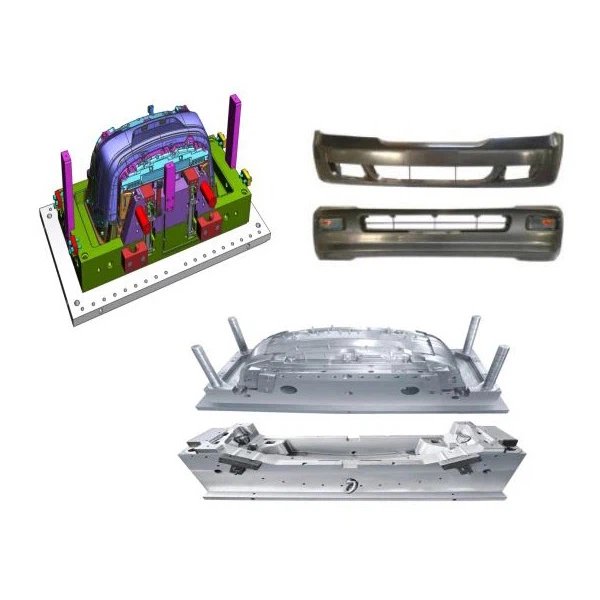
Epoxy Resin
Epoxy resin is sometimes used for making prototype grille moulds. It is a low - cost material that can be easily cast into the desired shape. Epoxy resin moulds can be quickly fabricated, which is useful for concept development and design verification. However, they have limited durability and are not suitable for high - volume production. They can be used to produce a small number of grille parts to test the design, fit, and function before investing in a more expensive steel or aluminum mould.
Impact of Material Choice on Grille Mould Performance
The choice of material for a grille mould has a significant impact on its performance.
- Surface Finish: As mentioned earlier, materials like P20 steel have good polishability, which directly affects the surface finish of the grille part. A smooth and high - quality surface finish on the mould will result in a grille with a better appearance, which is important for the automotive market where aesthetics are highly valued.
- Wear Resistance: For high - volume production, materials with high wear resistance, such as D2 steel, are essential. A mould with good wear resistance can maintain its dimensional accuracy over a large number of production cycles, ensuring consistent quality of the grille parts.
- Cost: Different materials have different costs associated with them. Steel is generally more expensive than aluminum and epoxy resin. However, the long - term cost - effectiveness also needs to be considered. A more expensive steel mould may have a longer service life and lower per - part production costs in high - volume production, while a cheaper epoxy resin mould may be more suitable for short - term or prototype projects.
- Production Cycle Time: Materials with good thermal conductivity, like beryllium copper, can reduce the production cycle time by allowing faster cooling of the plastic in the mould. Shorter cycle times mean higher production efficiency and lower costs in the long run.
Conclusion
In conclusion, there are various materials available for making grille moulds, each with its own advantages and disadvantages. As a grille mould supplier, we need to carefully consider the customer's requirements, such as production volume, surface finish, and budget, when selecting the appropriate material. Whether it is the high - performance tool steels for large - scale production, the lightweight aluminum for prototyping, or the special - purpose materials like beryllium copper, each material plays a unique role in the grille mould manufacturing process.
If you are in the market for high - quality grille moulds and are interested in learning more about our products and how the material choice can impact your production, we encourage you to contact us for further discussion. We are committed to providing the best solutions for your grille mould needs and look forward to the opportunity to work with you.
References
- "Handbook of Mold Design" by John R. Beatty
- "Plastics Materials and Processing" by Charles A. Harper
- "Tool and Manufacturing Engineers Handbook" by Society of Manufacturing Engineers