

In the automotive manufacturing industry, the rear bumper is not only a crucial safety component but also an important part of the vehicle's exterior aesthetics. As a rear bumper mould supplier, we understand the significance of every step in the mould - making process, especially the polishing of the mould cavity. This blog post will delve into the requirements for the mould cavity polishing in a rear bumper mould.
Surface Finish Requirements
The surface finish of the mould cavity has a direct impact on the appearance and quality of the final rear bumper product. For most automotive applications, a high - gloss finish is desired. This is because a smooth and shiny surface not only enhances the visual appeal of the bumper but also makes it easier to clean and maintain.
The Ra (arithmetical mean deviation of the profile) value is commonly used to measure the surface roughness. In the case of rear bumper moulds, the Ra value typically needs to be below 0.05μm for a mirror - like finish. Achieving such a low Ra value requires a multi - step polishing process.

First, coarse grinding is carried out using abrasive tools with relatively large grit sizes. This helps to remove any machining marks left from the previous manufacturing processes, such as milling or EDM (Electrical Discharge Machining). After coarse grinding, medium - grit abrasive papers or polishing compounds are used to gradually refine the surface. Finally, fine - grit polishing is performed to achieve the desired smoothness.
Dimensional Accuracy
During the polishing process, it is essential to maintain the dimensional accuracy of the mould cavity. Any deviation in dimensions can lead to problems with the fit and assembly of the rear bumper on the vehicle.
The polishing operation should be carefully controlled to ensure that the shape and size of the mould cavity remain within the specified tolerances. For example, the wall thickness of the rear bumper is a critical dimension. If the polishing process removes too much material from the mould cavity, the resulting bumper may be thinner than required, which can affect its strength and durability.
To maintain dimensional accuracy, precision measuring tools such as coordinate measuring machines (CMMs) are often used. These machines can accurately measure the dimensions of the mould cavity at different stages of the polishing process, allowing for timely adjustments if necessary.
Uniformity of Polishing
Uniformity is another key requirement for the mould cavity polishing in a rear bumper mould. A non - uniform surface finish can result in visible defects on the final bumper, such as streaks or uneven gloss.
To achieve uniformity, the polishing process should be carried out in a systematic manner. The polishing tools should be applied evenly across the entire surface of the mould cavity. In some cases, automated polishing equipment can be used to ensure consistent pressure and movement during the polishing operation.
Moreover, the operator needs to pay attention to the corners and edges of the mould cavity. These areas are often more difficult to polish due to their complex geometries. Special care should be taken to ensure that the polishing quality in these areas is the same as that of the flat surfaces.
Compatibility with the Mould Material
The choice of polishing method and tools depends on the material of the mould. Rear bumper moulds are commonly made of high - strength steels or alloys, such as P20, 718, or H13.
Different materials have different hardness and surface characteristics, which require specific polishing techniques. For example, harder materials may require more aggressive polishing methods initially, but also need to be carefully finished to avoid surface damage.
When using abrasive tools, it is important to select the appropriate grit size and type of abrasive depending on the mould material. For softer materials, finer - grit abrasives can be used from the beginning to prevent excessive material removal.
Resistance to Wear and Erosion
The mould cavity needs to be able to withstand the wear and erosion caused by the injection molding process. During injection molding, the molten plastic is injected into the mould cavity at high pressure and temperature. This can cause abrasion and chemical corrosion on the surface of the mould cavity.
A well - polished surface can improve the resistance of the mould cavity to wear and erosion. A smooth surface reduces the friction between the molten plastic and the mould cavity, minimizing the wear. Additionally, a high - quality polish can also provide a certain degree of protection against chemical corrosion.
To enhance the wear and erosion resistance, some moulds may undergo additional surface treatments after polishing, such as nitriding or coating. These treatments can further improve the hardness and chemical stability of the mould surface.
Compatibility with the Plastic Material
The rear bumper is usually made of plastic materials such as polypropylene (PP) or acrylonitrile butadiene styrene (ABS). The polished surface of the mould cavity should be compatible with these plastic materials.
Some plastic materials have a tendency to stick to the mould surface during the injection molding process. A properly polished surface can reduce the adhesion between the plastic and the mould, making it easier to eject the finished bumper from the mould. This not only improves the production efficiency but also reduces the risk of damage to the bumper during ejection.
Applications in the Automotive Industry
In the automotive industry, the quality of the rear bumper mould directly affects the quality of the final product. A well - polished mould cavity can produce rear bumpers with excellent surface finish, dimensional accuracy, and mechanical properties.
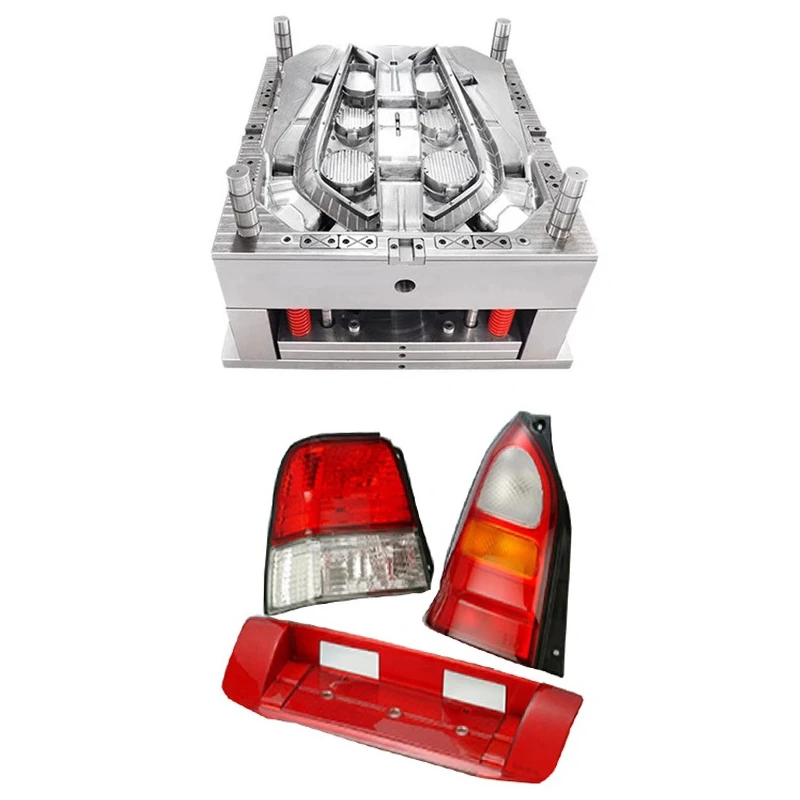
Our company, as a rear bumper mould supplier, has rich experience in meeting these requirements. We have advanced manufacturing equipment and a professional R & D team. Our products, such as Car Lamp Injection Mold, Compression Molds For Automotive, and Bumper Injection Mould, are widely used in the automotive manufacturing process.
Conclusion
The requirements for the mould cavity polishing in a rear bumper mould are multi - faceted, including surface finish, dimensional accuracy, uniformity, compatibility with the mould and plastic materials, and resistance to wear and erosion. Meeting these requirements is crucial for producing high - quality rear bumpers that meet the strict standards of the automotive industry.
If you are in the market for high - quality rear bumper moulds or have any questions about the mould cavity polishing process, we invite you to contact us for further discussions and potential procurement negotiations. We are committed to providing you with the best solutions and products.
References
- “Mould Polishing Technology” by John Smith, published by Automotive Moulding Press.
- “Advanced Materials for Automotive Moulds” by Emily Brown, Journal of Automotive Manufacturing, 2022.
- “Injection Molding Process and Mould Design” by David Wilson, Springer Publishing.