

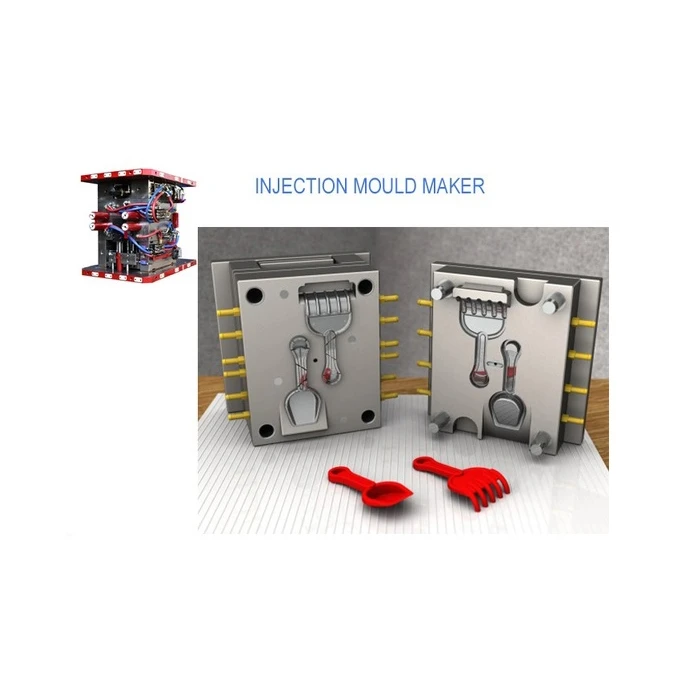
Hey there! I'm a supplier of Plastic Toy Mould, and today I wanna share some insights on how to design an efficient cooling system for a plastic toy mould.
First off, let's understand why a good cooling system is so crucial. When we're making plastic toys, the molten plastic is injected into the mould. After that, it needs to cool down and solidify to take the shape of the toy. If the cooling process isn't efficient, it can lead to all sorts of problems. For example, the toy might have uneven shrinkage, which can cause warping or dimensional inaccuracies. And that's a big no - no when it comes to producing high - quality plastic toys.
Factors to Consider in Cooling System Design
Material of the Mould
The material of the plastic toy mould plays a huge role in cooling. Different materials have different thermal conductivities. For instance, steel is a commonly used material for moulds. It has a relatively high thermal conductivity, which means it can transfer heat away from the molten plastic fairly quickly. But some special alloys or composites might offer even better heat transfer properties. We need to choose the right material based on the type of plastic we're using and the complexity of the toy design. If we're dealing with a toy that has thin walls and detailed features, a material with excellent thermal conductivity can help ensure uniform cooling and prevent defects.
Shape and Size of the Toy
The shape and size of the plastic toy are also important. A large toy will generally take longer to cool than a small one. And if the toy has a complex shape with thick and thin sections, it can be a challenge to cool it evenly. For example, a Child Safety Seat Mold is relatively large and has various contours. We need to design the cooling channels in a way that they can reach all parts of the mould effectively. For areas with thick sections, we might need to have more cooling channels or use a more powerful cooling medium to speed up the cooling process.
Type of Plastic
Different plastics have different cooling requirements. Some plastics cool down quickly, while others take longer. For example, polypropylene cools relatively fast, while polycarbonate takes more time. We need to know the specific cooling characteristics of the plastic we're using. This information can help us determine the flow rate and temperature of the cooling medium, as well as the layout of the cooling channels. If we use a cooling system that's designed for a fast - cooling plastic on a slow - cooling one, the toy might not cool properly, leading to poor quality.
Designing the Cooling Channels
Layout
The layout of the cooling channels is key to an efficient cooling system. We want to make sure that the cooling medium can flow smoothly through the channels and reach all parts of the mould. One common layout is the spiral or serpentine design. This type of layout allows the cooling medium to cover a large area of the mould in a relatively small space. It also helps in maintaining a more uniform temperature distribution.
Another option is the baffle - type design. In this design, baffles are placed inside the cooling channels to direct the flow of the cooling medium. This can be useful for complex - shaped moulds where a simple straight - through channel might not be sufficient. We need to carefully plan the layout based on the shape and size of the toy and the mould. For a Baby Car Mold, which has a lot of curves and details, a well - designed spiral or baffle - type cooling channel layout can make a big difference in the cooling efficiency.
Diameter and Spacing
The diameter of the cooling channels is also important. If the channels are too small, the flow of the cooling medium might be restricted, which can reduce the cooling efficiency. On the other hand, if the channels are too large, it can lead to uneven cooling. We need to find the right balance. Generally, the diameter of the cooling channels should be determined based on the size of the mould and the flow rate of the cooling medium.
The spacing between the cooling channels is equally crucial. If the channels are too far apart, there will be areas in the mould that don't get enough cooling. If they're too close together, it can increase the manufacturing cost and might also cause structural issues in the mould. We need to calculate the optimal spacing based on the heat transfer requirements of the plastic toy.
Choosing the Cooling Medium
Water
Water is one of the most commonly used cooling media. It has a high specific heat capacity, which means it can absorb a large amount of heat without a significant increase in temperature. It's also relatively inexpensive and easy to handle. We can use tap water in many cases, but for more precise cooling requirements, we might need to use de - ionized water to prevent scaling and corrosion in the cooling channels.
Refrigerants
In some cases, refrigerants can be used as a cooling medium. They can provide very low - temperature cooling, which is useful for plastics that require rapid cooling. However, refrigerants are more expensive and require special handling and equipment. We need to carefully consider the cost - benefit ratio before choosing a refrigerant as the cooling medium.
Monitoring and Controlling the Cooling System
Once the cooling system is designed and installed, we need to monitor and control it effectively. We can use temperature sensors to measure the temperature of the mould at different points. This data can help us adjust the flow rate and temperature of the cooling medium in real - time. For example, if we notice that a certain area of the mould is cooling too slowly, we can increase the flow rate of the cooling medium in that area.
We also need to regularly maintain the cooling system. This includes checking for leaks, cleaning the cooling channels to prevent blockages, and ensuring that the pumps and other components are working properly. A well - maintained cooling system will not only ensure efficient cooling but also extend the lifespan of the plastic toy mould.

Conclusion
Designing an efficient cooling system for a plastic toy mould is a complex but crucial task. By considering factors like the material of the mould, the shape and size of the toy, the type of plastic, and choosing the right cooling channels and medium, we can achieve uniform and rapid cooling. This will result in high - quality plastic toys with fewer defects.
If you're in the market for Plastic Toy Mould or need advice on designing a cooling system for your plastic toy production, don't hesitate to reach out. We're here to help you optimize your manufacturing process and create amazing plastic toys.
References
- "Plastic Injection Molding Handbook" by O. Olabisi
- "Mold Cooling Design Guide" by Mold - Tech International