

In the automotive industry, grille covers play a crucial role not only in protecting the radiator and other components but also in enhancing the aesthetic appeal of vehicles. As a leading Grille Cover Mould supplier, we often encounter a common question from our clients: Can a grille cover mould be used for making grille covers with different textures? In this blog post, we will delve into this topic and provide a comprehensive answer based on our expertise and industry knowledge.
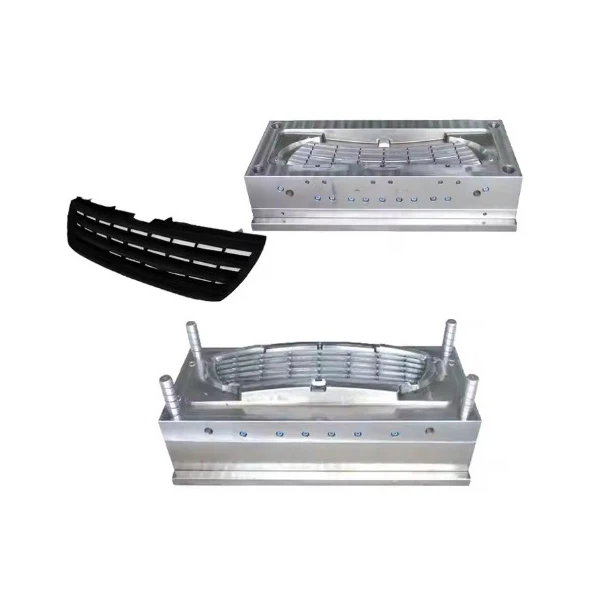

Understanding Grille Cover Moulds
Before we explore the possibility of using a single grille cover mould for different textures, let's first understand what grille cover moulds are and how they work. Grille cover moulds are precision tools used in the injection moulding process to manufacture grille covers. The injection moulding process involves injecting molten plastic into a mould cavity, where it cools and solidifies to take the shape of the mould.
There are different types of grille cover moulds available in the market, each designed for specific applications and requirements. For example, Automotive Grille Injection Mould is specifically designed for producing automotive grille covers, while Radiator Grille Mould is used for making radiator grille covers. Our Grille Cover Mould is a versatile tool that can be customized to meet the specific needs of our clients.
Factors Affecting Texture in Grille Covers
Texture is an important aspect of grille covers as it can significantly impact the overall appearance and feel of the vehicle. There are several factors that can affect the texture of grille covers, including the material used, the mould design, and the injection moulding process.
- Material Selection: The choice of material plays a crucial role in determining the texture of the grille cover. Different plastics have different properties, such as hardness, flexibility, and surface finish, which can affect the texture of the final product. For example, polypropylene (PP) is a commonly used material for grille covers due to its low cost, high strength, and good chemical resistance. However, it may have a smooth surface finish, which may not be suitable for some applications. On the other hand, thermoplastic elastomers (TPE) can provide a soft and rubbery texture, which can enhance the grip and comfort of the grille cover.
- Mould Design: The design of the mould can also have a significant impact on the texture of the grille cover. The surface finish of the mould cavity can be polished, etched, or textured to create different effects on the final product. For example, a polished mould cavity can produce a smooth and shiny surface finish, while an etched or textured mould cavity can create a matte or textured surface finish. Additionally, the design of the mould can also include features such as ribs, grooves, or patterns, which can further enhance the texture of the grille cover.
- Injection Moulding Process: The injection moulding process itself can also affect the texture of the grille cover. Factors such as the injection pressure, temperature, and speed can all impact the flow of the molten plastic and the way it fills the mould cavity. If the injection pressure is too high, it can cause the plastic to flow too quickly and result in a rough or uneven surface finish. On the other hand, if the injection pressure is too low, it can cause the plastic to flow too slowly and result in a incomplete filling of the mould cavity, which can also affect the texture of the final product.
Can a Grille Cover Mould be Used for Different Textures?
The answer to this question is both yes and no. In some cases, a single grille cover mould can be used to produce grille covers with different textures. However, this depends on several factors, such as the design of the mould, the material used, and the injection moulding process.
- Yes, it can be possible: If the mould is designed with a modular or interchangeable insert system, it can be relatively easy to change the texture of the grille cover. For example, the mould can be designed with a removable insert that can be replaced with a different insert having a different surface finish or texture. This allows for quick and easy changes to the texture of the grille cover without having to replace the entire mould. Additionally, some advanced injection moulding techniques, such as multi-material injection moulding or in-mould decoration (IMD), can also be used to create different textures on the same grille cover.
- No, it may not be possible: However, in some cases, it may not be possible to use a single grille cover mould to produce grille covers with different textures. For example, if the texture requires a significant change in the mould design or the injection moulding process, it may be necessary to use a different mould. Additionally, if the material used for the grille cover is not compatible with the texture requirements, it may also be necessary to use a different material or a different mould.
Advantages and Disadvantages of Using a Single Mould for Different Textures
There are several advantages and disadvantages of using a single grille cover mould for different textures.
- Advantages:
- Cost Savings: Using a single mould for different textures can significantly reduce the cost of tooling. Instead of investing in multiple moulds for different textures, a single mould can be used, which can save a significant amount of money in the long run.
- Flexibility: A single mould with a modular or interchangeable insert system can provide greater flexibility in production. It allows for quick and easy changes to the texture of the grille cover, which can help to meet the changing demands of the market.
- Consistency: Using a single mould can also ensure greater consistency in the quality and appearance of the grille covers. Since the same mould is used for all textures, the dimensions and tolerances of the grille covers are more likely to be consistent, which can improve the overall quality of the final product.
- Disadvantages:
- Limitations in Texture Variety: While a single mould can be used to produce grille covers with different textures, there may be limitations in the variety of textures that can be achieved. The texture options may be limited by the design of the mould and the injection moulding process.
- Complexity in Production: Using a single mould for different textures may require more complex production processes and techniques. For example, changing the texture of the grille cover may require changing the insert in the mould, which can be time-consuming and may require additional equipment and expertise.
- Compatibility Issues: There may also be compatibility issues between the material used for the grille cover and the texture requirements. Some materials may not be suitable for certain textures, which may require the use of a different material or a different mould.
Conclusion
In conclusion, whether a grille cover mould can be used for making grille covers with different textures depends on several factors, including the design of the mould, the material used, and the injection moulding process. In some cases, a single mould can be used to produce grille covers with different textures, especially if the mould is designed with a modular or interchangeable insert system. However, in other cases, it may be necessary to use a different mould or a different material to achieve the desired texture.
As a Grille Cover Mould supplier, we have the expertise and experience to help our clients determine the best solution for their specific needs. We can work closely with our clients to understand their requirements and design a mould that can produce grille covers with the desired texture. Whether you are looking for a smooth and shiny surface finish or a matte or textured surface finish, we can provide you with a customized solution that meets your needs and budget.
If you are interested in learning more about our Grille Cover Moulds or would like to discuss your specific requirements, please feel free to contact us. We look forward to hearing from you and working with you to create high-quality grille covers for your vehicles.
References
- "Injection Moulding Handbook" by O. Olajide and M. A. Adewale
- "Plastics Materials" by J. A. Brydson
- "Automotive Engineering Design" by J. Crolla and P. J. Crolla