

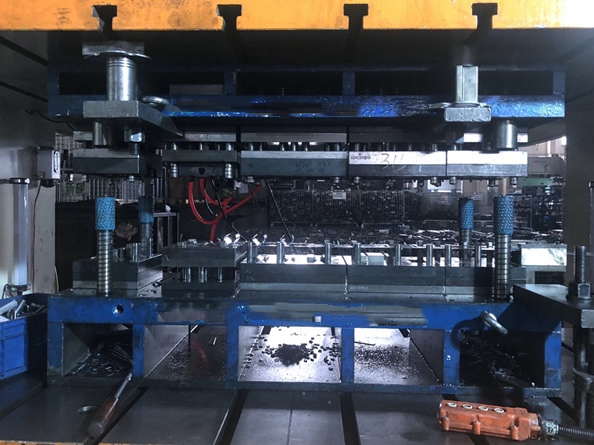
At present, the common sheet metal pressing method for body-in-white is hemming. Hemming usually has two forms of implementation: hemming and hemming. Hemming refers to traditional mold hemming. Use a press or some cylinders to drive the pressing block to compress the hemming and wrap another part to achieve the purpose of assembly. The hemming roller (usually driven by a robotic arm) is used to fold the hemming and wrap another part to achieve assembly.
Both methods can ensure that the surface of the component after hemming is smooth and flat, and there are no surface defects such as crushing, convex and concave, and the shape surface and the overall size along the circumference are accurate and stable.
I) Digital parameters of hemming
1. Flanging height
The hemming length has a certain relationship with the hemming height of the outer panel. Generally speaking, the definition of the hemming height directly determines the feasibility and appearance quality of the hemming. According to the empirical value, when the four-door and two-cover panels are pressed together, if the pressing section is a flat straight edge, the numerical parameters of the hemming.
In addition to the general hemming straight line segment, there are some special parts whose hemming length is somewhat different from the general value. For example, at the corners of the hemming of doors and covers, in order to avoid wrinkles after hemming, notches are generally opened on the outer panel.
In other places, such as drainage holes (generally there are three in the front door and 2 to 3 in the rear door), the hemming length is also different from that of general parts, and the hemming length here is changed by less than 30% of the normal hemming length.
2. Feasibility of inner and outer panel assembly
Before the four-door and two-cover panels are pressed together, the inner and outer panels need to be assembled, that is, the inner panel is placed in the outer panel, but due to the shape or some other needs, the outer panel has a large angle in the shape, and it is difficult or impossible to assemble the inner and outer panels at this time.
Outer panel angle and inner and outer panels.
II) Hemming defects
The stamping die door cover hemming process is the last process of the assembly of the four-door and two-cover product assembly. Its hemming quality directly affects the overall appearance and sealing performance of the product. After assembly, it is necessary to maintain a uniform assembly gap with the surrounding parts to achieve good appearance and interchangeability.
According to the technical requirements of the body assembly, the outer surface of the product must be smooth after hemming, without defects such as indentations, depressions, undulations and obvious wrinkles. The inner and outer panels must be flat and fit together, and the overall size of the workpiece must be accurate and stable.
The quality of hemming includes two aspects: dimensional accuracy and surface appearance quality, which directly affects the sealing and appearance quality of the body assembly.
1. Size
Stamping die hemming is a complex sheet metal forming process. In actual industrial production, the indentation formed during the hemming of the door cover is the main reason for the uneven clearance between the door cover product and its surrounding parts.
Gap indentation (roll-in) refers to the end position of the hemming being inside the ideal position. It is caused by the change in the size of the outer layer plate due to the movement of the hemming edge during the hemming process. It generally occurs in the final hemming process.
With the development of the automobile industry, the gap of the whole vehicle assembly must be reduced. Therefore, compared with eliminating creep, predicting, compensating and controlling creep is more important.
Due to the complex shape of the hemmed parts, the hemming process produces different roll-in values in different areas. At the straight edge of the plane, the roll-in value is basically the same, while at the corners and where the curvature changes sharply, the roll-in value changes greatly.
The roll-in value directly determines the assembly gap of the panel and affects the appearance quality of the whole vehicle. According to the different hemming processes, the roll-in value also varies. The roll-in value of the die hemming is usually 0.5mm, and the roll-in value of the rolling hemming is usually 0.2~0.3mm.
2. Appearance
The surface appearance quality of the stamping die is another important factor affecting the sealing and appearance quality of the body assembly, which is mainly reflected in three aspects: the outer surface, the outer panel corner and the inner surface. Common appearance defects include uneven hemming, unsteady hemming, and deformation of hemming.
Among them, the main reason for uneven hemming is that the size of the material edge of the stamping part at the relevant part is out of tolerance (too long), the main reason for unsteady hemming is that the material edge of the outer sheet at the relevant part is too short, and the main reason for deformation of hemming is generally that the excessively long material edge interferes with the hemming die or the die limit block during the hemming process.
The car door is the exterior assembly of the car body. After assembly, it is required to maintain a uniform door gap and good shape surface difference with the surrounding parts. Door hemming is a relatively special process method in the manufacture of car door assemblies. After hemming, the assembly surface is required to be smooth, flat and free of external defects such as crushing, convexity and concave. It is also necessary to ensure that the overall size of the door shape surface and the periphery is accurate and stable. Therefore, the requirements for equipment and tooling are also very high. At the same time, the requirements for related parts such as the outer and inner panels of the car door are very high, so that high-quality car door assemblies can be manufactured. In order to obtain good body assembly accuracy and appearance quality, the hemming and pressing process of the car door requires not only good tooling, equipment and high-precision inner and outer sheet metal parts of the car door, but also accurate and advanced manufacturing processes.