

What are the processes of stamping dies for automotive parts?
Automotive parts stamping dies generally have the following processes:
1. Drawing and forming
2. Trimming and punching (side trimming and side punching)
3. Flanging and shaping (side flanging and side shaping)
Drawing and forming:: It is a stamping process method that turns a metal flat sheet cut into a certain shape into parts of various shapes under the action of tensile stress.
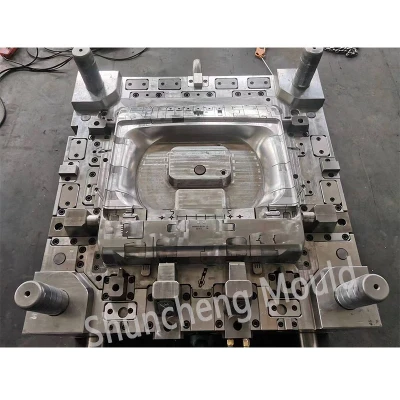
Key points of drawing die design:
1. Arrangement of pressure regulating pads Arrangement of pressure regulating pads
The adjustment pads are arranged close to the pressing surface, and each adjustment pad is arranged close to the pressing surface, one every 300~400;
At the corresponding position of the adjustment pad, the lower die is set with a pier dead block; the corresponding positions of the adjustment pad, pier dead block, and ejector rod should have vertical ribs.
2. A material locator should be set on the pressure ring to ensure the stable placement of the sheet. A material locator should be set on the pressure ring to ensure the stable placement of the sheet.
3. The end guide plate of the stamping die should be set with anti-reverse, in the form of the left side of the stamping die being 10mm larger than the right side. A peephole should be set at the guide plate.
4. A safety screw should be set, and the screw length should ensure that there is a 20 mm gap when the blank holder is at the top dead center.
5. A safety protection plate should be set between the blank holder and the lower template, and the height of the protection plate should ensure that the blank holder has a covering height of 30 mm when the blank holder is at the top dead center.
6. A transport connection plate is set between the upper and lower molds. A transport connection plate is set between the upper and lower molds.
7. Requirements for the arrangement of ejector pins: evenly distributed along the parting line to ensure that the blank holder is under stable force.