

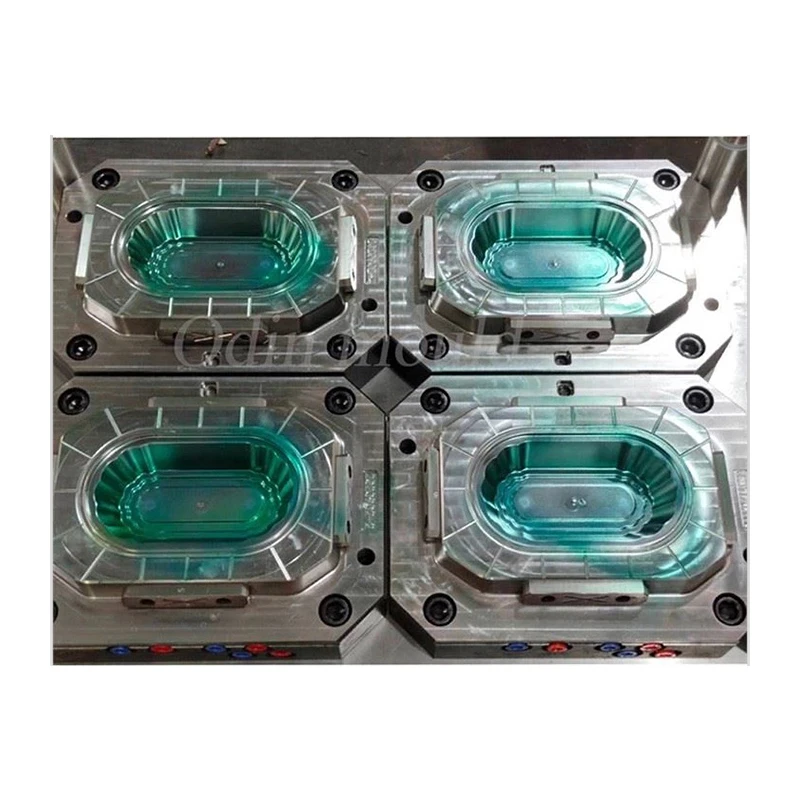
The molding processes of plastic packaging boxes mainly include injection molding, extrusion molding, blow molding, etc. Among them, injection molding is the most commonly used molding process for plastic packaging boxes due to its simple process, easy operation, and strong repeatability of molded products.
Injection molding, also known as injection molding or injection molding. This is an important polymer material molding and processing method. Injection molded products are widely used, accounting for about 80% of engineering plastic products and 30% of total plastic products.
In simple terms, when the wall thickness is less than 1mm, it is called thin wall. More comprehensively, the definition of thin wall is related to the process/wall thickness ratio, the viscosity of the plastic, and the heat transfer coefficient.

1. The ratio of flow length to thickness L/T, that is, the ratio of the flow length L from the melt entering the mold to the farthest point of the cavity where the melt must be filled and the corresponding average wall thickness T is 100 or 150 or more. Injection molding is considered thin. wall injection molding;
2. Injection molding method where the thickness of the molded plastic part is less than 1 mm and the projected area of the plastic part is more than 50 c㎡;
3. Injection molding with a wall thickness of less than 1 mm (or 1.5mm), or t/d (plastic part thickness t, plastic part diameter d, for disc-shaped plastic parts) below 0.05 is defined as thin-walled Injection molding.

The essence of thin-wall filling
The mold walls are cold and form a solidified layer as the melt fills the mold cavity, thus reducing the thickness of the flowable channels. This situation is more serious when the wall thickness is thinner. A 1mm wall thickness has a 0.2mm thick solidified layer, leaving a 0.6mm thick flow channel. A 0.5mm wall thickness has a 0.2mm thick solidified layer, leaving a 0.1mm thick flow channel. When the filling is not completed and the flow channel disappears due to the solidified layer being too thick, the finished product will not be filled enough.

Plastic material
Use high-flow plastics. The melt index (MI) of PP plastics is as high as 60 (g/10min), such as Basell's Moplen RP1086. The reason why many finished products use PS/ABS is that the toughness of PC and the fluidity of ABS are required, and it is also suitable for thin-wall injection molding.
c raw materials that are widely used in thin-wall injection molding include polystyrene (PS), polypropylene (PP), polycarbonate (PC), acrylonitrile-butadiene-styrene (ABS), and PC/ABS blends. Materials and PA6, etc. These plastic raw materials usually have good fluidity, large flow length, high impact strength, high heat distortion temperature, high thermal stability, low directionality and good dimensional stability.

Taking polypropylene (PP) as an example, polypropylene has good chemical stability to most acids, alkalis, solvents, greases and other chemicals except oxygen, and the chemical stability increases with the increase of crystallinity. For tableware, because it has to hold high-temperature food, it has higher requirements on the properties of materials under high-temperature conditions. The melting point of polypropylene can reach 175°C, and it can withstand hot water cooking and sterilization. Even when no external force is applied, its products will not deform at 150°C.
For thin-walled injection molded plastic packaging products, compared with ordinary injection molded products, on the one hand, there are difficulties in the injection molding of thin-walled injection molded parts, such as warping deformation, lack of material, pores, etc.; on the other hand, there are also difficulties in the injection molding of packaging box products. Difficulties, such as: high appearance requirements, certain products requiring higher precision, etc. The production and processing of packaging plastic products is developing in the direction of high speed, high precision and high automation, and there is still much to explore in the future.


Hot Tags: plastic thin wall food container packaging box mould, China plastic thin wall food container packaging box mould manufacturers, suppliers, factory, cutlery plastic mould, housewares for dining plastic mold, plastic lunch box mould, bowl plastic mold, bucket plastic mold, household products plastic mold