

Stamping process of the four major processes in automobile manufacturing
The automobile is called "the machine that changes the world". Because the automobile industry has a strong industrial correlation, it is regarded as an important symbol of a country's economic development level. There are four major processes in automobiles, and the stamping process is the top priority of the four major processes.
1. Concept of stamping
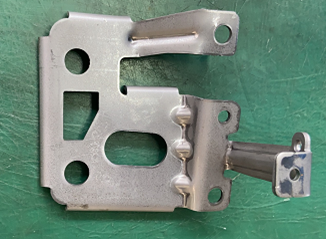
Stamping is a forming method that relies on presses and dies to apply external forces to plates, strips, pipes and profiles to cause plastic deformation or separation, thereby obtaining workpieces (stamping parts) of the required shape and size. Stamping and forging belong to plastic processing (or pressure processing), collectively known as forging. The blanks for stamping are mainly hot-rolled and cold-rolled steel plates and steel strips. Among the steel materials in the world, 60-70% are plates, most of which are stamped into finished products.
The body, chassis, fuel tank, radiator fins of automobiles, the steam drum of boilers, the shell of containers, the iron core silicon steel sheets of motors and electrical appliances, etc. are all stamped. There are also a large number of stamping parts in products such as instruments, household appliances, bicycles, office machinery, and daily utensils.
2. Characteristics of stamping process
A. Stamping is a processing method with high production efficiency and low material consumption. The stamping process is suitable for the production of large batches of parts and products, which is easy to realize mechanization and automation, and has high production efficiency. At the same time, stamping production can not only strive to achieve less waste and no waste production, but also make full use of the leftovers in some cases.
B. The operation process is convenient and does not require the operator to have a high level of skills.
C. The stamped parts generally do not need to be machined again and have high dimensional accuracy.
D. Stamping parts have good interchangeability. The stamping process has good stability, and the same batch of stamping parts can be used interchangeably without affecting assembly and product performance.
E. Since stamping parts use sheet materials, their surface quality is good, which provides convenient conditions for subsequent surface treatment processes (such as electroplating and painting).
F. Stamping can produce parts with high strength, high rigidity and light weight.
G. Stamping parts mass-produced with molds are inexpensive.
H. Stamping can produce parts with complex shapes that are difficult to produce with other metal processing methods.
3. Introduction to stamping process
The mechanical steering system uses the driver's physical strength as the source of steering power, and all mechanical transmission structures are mechanical. The mechanical steering system consists of three major parts: steering control mechanism, steering gear and steering transmission mechanism.
A. Separation process
The sheet metal is separated along a certain contour line under the action of external force to obtain finished products and semi-finished products with certain shape, size and cut surface quality. Separation condition: the stress inside the deformed material exceeds the strength limit σb.
a. Blanking
Use a punch to punch along a closed curve, and the punched part is a part. Used to manufacture flat parts of various shapes.
b. Punching
Use a punch to punch along a closed curve, and the punched part is waste. There are several forms such as positive punching, side punching, and hanging punching.
c. Trimming
Trim the edges of the formed parts neatly or cut them into a certain shape.
d. Separation
Use a punch to punch along an unclosed curve to produce separation.
When the left and right parts are formed together, the separation process is used more frequently.
B. Forming process
The blank is plastically deformed without breaking to obtain finished products and semi-finished products of certain shapes and sizes.
Forming conditions: yield strength σS < material internal stress < strength limit σb.
a. Drawing
Forming the sheet blank into various open hollow parts.
b. Flanging
Forming the edge of the sheet or semi-finished product along a certain curve with a certain curvature to form a vertical edge.
c. Shaping
A forming method used to improve the dimensional accuracy of the formed parts or to obtain a small fillet radius.
d. Flanging
Make vertical edges on pre-punched sheets or semi-finished products or unpunched sheets.
e. Bending
Bend the sheet into various shapes along a straight line, and parts with extremely complex shapes can be processed.