

Injection Molding Market Size & Trends
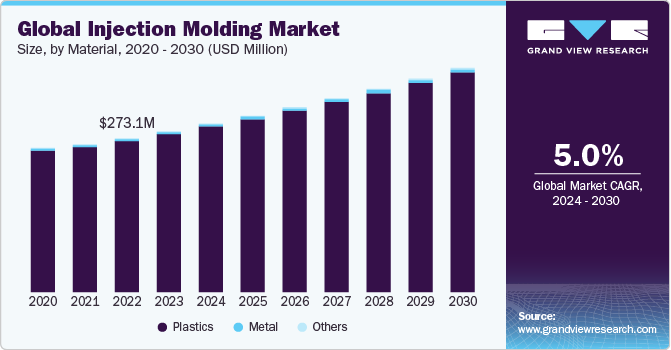
The global injection molding market size was estimated at USD 285.5 billion in 2023 and is projected to grow at a CAGR of 4.9% from 2024 to 2030. The growing demand for injection molded components in the automotive industry is driving the demand for the market over the forecast period. Injection molding is suitable for producing a wide variety of exterior automobile components such as mudguards, door panels, wheel arches, grilles, trunk trims, front and rear covers, and outside car door trims. Injection molding is a crucial manufacturing process employed for developing different components used in the automotive industry as safety, consistency, and quality are critical for this industry.
To learn more about this report, request a free sample copy
In the U.S., the growing adoption of electric vehicles is driving the demand for light weight electric vehicle exterior components made of plastics. In addition, the favorable government regulations & initiatives, infrastructure availability, high expenditure on research & development, etc. are likely to contribute to the growth of electric vehicle manufacturing. For instance, Hyundai Motor Group announced a new electric vehicle factory in Georgia, U.S. in February 2024. The factory is set to open in 2025 with an annual production capacity of 300,000 electric vehicles.
Further, the federal government is providing support in the form of tax rebates and subsidies have further fueled the demand for electric vehicles. Increasing demand for injection molded components in both, conventional and electric vehicles for developing their interiors and exteriors, is expected to augment the growth of the market in the U.S. in the coming years.
Moreover, ongoing technological innovations in injection molding are propelling the market expansion. Technologically advanced injection molding improves the productivity and surface finish of the components. For instance, Metal parts manufactured from Metal Injection Molding (MIM) technology are utilized to manufacture medical components owing to the lesser manufacturing time, elimination of secondary operations, and better tolerance levels of final products. Extensive technological advancement has fostered the development of a wide array of components that can be manufactured easily with differing sizes and high complexities using the injection molding process.
At the global level, increasing penetration of injection molded plastic products in healthcare is one of the factors driving the market. Plastic is cost-effective, does not rust or corrode like metal, lightweight opposed to other material, pliable, and it can be molded into more complex shapes, sizes, and patterns. These factors are increasing the demand for plastics in healthcare products.