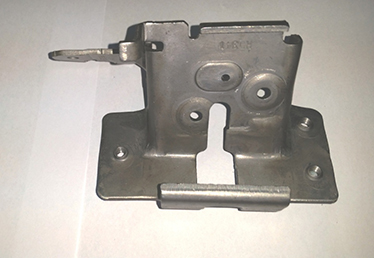
Treatment methods for common problems in die stamping
Stamping is one of the production processes for mass-produced parts. Die failure is a common problem in stamping production, which often causes production stoppage and affects the product production cycle. Therefore, it is necessary to find the cause of the die failure as soon as possible and repair it reasonably.
What are the reasons for the blockage of chips in die stamping parts, and what countermeasures should be taken?
The reasons and corresponding countermeasures for chip blockage in stamping parts are:
1) The leakage hole is too small, and the gap of the leakage hole can be increased;
2) The leakage hole is too large, and the chips roll over, so modify the leakage hole;
3) The blade is worn, the burrs are large, and the blade needs to be repaired;
4) The stamping oil drips too fast and the oil is sticky. The amount of oil dripping can be controlled and the oil type can be changed;
5) The surface of the straight blade of the die is rough, and the powder chips are sintered and attached to the blade. The surface roughness can be reduced by surface treatment and polishing or the material can be changed;
6) The material is soft, and the blanking gap can be modified;
The emergency measures are:
The end face of the punch blade is repaired with an inclination or arc (pay attention to the direction), and a vacuum cleaner is used to blow air at the blanking hole of the pad.
What are the reasons for the deviation of material size during die stamping, and what countermeasures should be taken?
The main reasons for the deviation of the blanking size and the corresponding countermeasures are:
1) The punch and die blades are worn, resulting in burrs (larger shape, smaller inner hole), and the blades need to be repaired;
2) Improper design clearance, modify the design and control the processing accuracy;
3) The punch and die inserts of the blanking position are offset, and the clearance is uneven. The position accuracy and blanking clearance can be adjusted;
4) The guide pin is worn and the pin diameter is insufficient. The guide pin can be replaced;
5) The guide part is worn, and the guide pin and guide sleeve can be replaced;
6) The feeder feeding distance and material release are improperly adjusted, and the feeder should be readjusted;
7) The mold closing height is improperly adjusted, and the mold closing height should be readjusted;
8) The material stripping insert is worn, and there is no material pressing (strong pressing) function or the punching is small due to material pulling and flipping. The stripping insert can be ground or replaced, the strong pressing function can be increased, and the material pressing can be adjusted;
9) The stripping insert is pressed too deep, and the punching hole is too large. The mold needs to be adjusted to reduce the depth of the press;
10) The mechanical properties of the stamping material vary (the strength and elongation are unstable). The material needs to be replaced and the feed quality needs to be controlled;
11) The punching force causes the material to pull and cause the size to vary. The end face of the punch blade can be trimmed with an inclination or arc to improve the force condition during punching, or a guide function can be added to the stripping insert at the material removal part.