

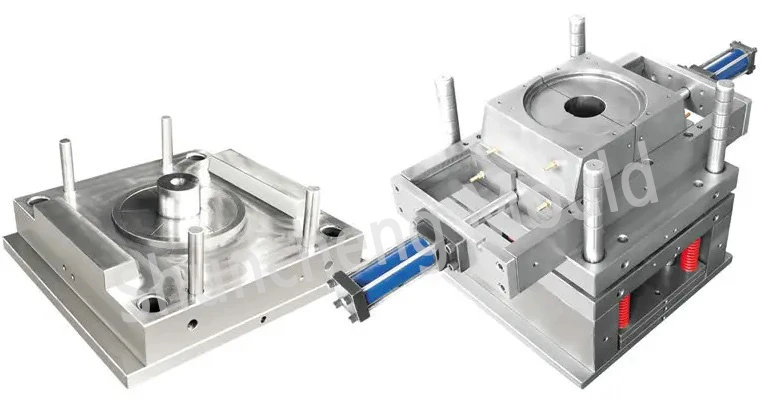
Principle of plastic injection mold
Injection molding is to inject plastic melt into the closed mold cavity at high speed under high pressure, and obtain a plastic product with the same shape as the mold cavity after cooling and shaping.
Injection molding must meet two necessary conditions: first, the plastic must be injected into the mold cavity in a molten state; second, the injected plastic melt must have sufficient pressure and flow rate to completely fill the mold cavity. Therefore, injection molding must have the basic functions of plasticizing, melt injection and pressure holding molding.
(1) Plasticizing process During the plasticizing process of injection molding, solid plastic is continuously moved forward along the screw groove through the conveying action of the rotating screw. After heating, compaction, shear mixing of the screw thread, the temperature is increased and converted into a viscous plastic fluid with uniform density, viscosity, composition and temperature distribution. The heat required for plasticizing solid plastic mainly comes from the heating of the plastic by the external barrel and the friction shear heat of the injection screw on the plastic. During the plasticization process, whether the temperature of the plastic melt meets the injection requirements and whether the temperature distribution is uniform are important parameters to measure the plasticization function of the injection molding machine. The plasticization function refers to the amount of molten plastic that the injection molding machine can provide per unit time.
After the solid plastic is plasticized into a melt, it is pushed to the head of the screw by the continuously rotating screw and stored in the storage area at the front end of the barrel. The plastic melt in the storage area has a certain pressure. The pressure of the melt acts on the screw to push the screw to overcome various resistances and retreat. After the screw retreats to a certain distance, it stops rotating. The volume of the plastic melt in the storage area (called the injection volume) is determined, the plasticization process ends, and the injection process begins.
(2) Injection process The plasticized plastic melt is stored in the storage area of the barrel. During injection, the screw moves axially. Under the action of the screw injection pressure, the plastic melt flows through the nozzle installed at the front end of the barrel, the mold pouring system, etc. at a certain rate and is injected into the mold cavity.
(3) Cooling and shaping process: The plastic melt injected into the mold cavity overcomes various flow resistances and fills the mold cavity. The plastic melt filling the mold cavity is subjected to huge pressure from the mold cavity, which drives the plastic melt to flow back to the barrel. Moreover, due to the cooling effect of the mold cavity, the plastic melt shrinks during cooling. At this time, the injection screw continues to provide pressure to keep the plastic melt filling the mold cavity without backflow, and appropriately replenishes the plastic melt into the mold cavity to fill the shrinkage space in the mold cavity until the plastic melt gradually cools and solidifies into a product.